Industrial Automation Trends: AI, Robotics, IIoT and OT Security
A practical guide to five industrial automation trends: AI-assisted operations, industrial robots, Industry 4.0, IIoT and OT cybersecurity. It explains how engineering and procurement teams can evaluate technology claims against operating evidence, integration requirements, safety controls, data quality, supportability and spare-parts risk before adoption. The article maps how connected assets, contextualised production data, human approval and lifecycle governance work together; outlines a 90-day evaluation plan; and identifies the product, revision, firmware, interface and documentation details required for responsible sourcing. It also includes representative product routes, field verification cases, editorial sources, a recent product-demonstration video from Moore Automated's YouTube channel, visible FAQs and a dedicated inquiry route for current, scarce and discontinued industrial automation parts. Final compatibility, cybersecurity, safety and regulatory decisions must still be confirmed for the exact installed system with current manufacturer documentation and qualified engineering review.
.ma-list-summary{display:none!important}
.ma-trends{--navy:#102b3c;--blue:#315f78;--red:#ed1c24;--pale:#f2f7fa;--line:#cfdde5;--ink:#18313f;--muted:#58707d;font-family:Arial,Helvetica,sans-serif;color:var(--ink);line-height:1.72;font-size:16px}.ma-trends *{box-sizing:border-box}.ma-trends a{color:var(--navy);text-decoration-thickness:1px;text-underline-offset:3px}.ma-trends h2,.ma-trends h3{color:var(--navy);line-height:1.18;margin-top:0}.ma-trends h2{font-size:clamp(28px,4vw,44px);margin-bottom:20px}.ma-trends h3{font-size:20px;margin-bottom:10px}.ma-trends p{margin:0 0 18px}.ma-trends .eyebrow{display:block;color:var(--red);font-size:12px;font-weight:800;letter-spacing:2px;text-transform:uppercase;margin-bottom:14px}.ma-trends .lead{font-size:20px;line-height:1.6;color:#294858}.ma-trends .panel{margin:38px 0;padding:clamp(24px,4vw,48px);background:#fff;border:1px solid var(--line)}.ma-trends .intro{display:grid;grid-template-columns:minmax(0,1.35fr) minmax(280px,.65fr);gap:42px;background:linear-gradient(120deg,#f8fbfd 0%,#edf6fa 100%);border-top:4px solid var(--red)}.ma-trends .facts{display:grid;gap:12px}.ma-trends .fact{background:#fff;border-left:3px solid var(--red);padding:16px 18px;box-shadow:0 7px 24px rgba(16,43,60,.06)}.ma-trends .fact strong{display:block;color:var(--navy);font-size:22px;line-height:1.2}.ma-trends .fact span{color:var(--muted);font-size:14px}.ma-trends .trend-grid{display:grid;grid-template-columns:repeat(2,minmax(0,1fr));gap:16px}.ma-trends .trend-card{position:relative;display:grid;grid-template-columns:160px minmax(0,1fr);grid-template-areas:"no copy" "title copy" "signal copy";column-gap:24px;row-gap:8px;min-height:0;padding:24px;background:#fff;border:1px solid var(--line);border-left:4px solid var(--blue)}.ma-trends .trend-card:nth-child(2n){border-left-color:var(--red)}.ma-trends .trend-card:last-child{grid-column:1/-1}.ma-trends .trend-no{grid-area:no;color:#9fb8c6;font-size:12px;font-weight:800;letter-spacing:1.4px}.ma-trends .trend-card h3{grid-area:title;margin-bottom:0}.ma-trends .trend-card p{grid-area:copy;color:var(--muted);font-size:14px;line-height:1.58;margin-bottom:0}.ma-trends .signal{grid-area:signal;align-self:end;width:max-content;padding:5px 8px;background:var(--pale);color:var(--blue);font-size:11px;font-weight:700;text-transform:uppercase;letter-spacing:.8px}.ma-trends .architecture{background:var(--navy);color:#fff}.ma-trends .architecture h2,.ma-trends .architecture h3{color:#fff}.ma-trends .architecture .eyebrow{color:#ff5a60}.ma-trends .path{display:grid;grid-template-columns:repeat(5,1fr);gap:1px;background:#426274;border:1px solid #426274}.ma-trends .step{background:#17384b;padding:22px 16px;min-height:180px}.ma-trends .step b{display:block;color:#ff6268;font-size:12px;letter-spacing:1.5px;margin-bottom:14px}.ma-trends .step p{font-size:14px;color:#d8e4ea;margin:0}.ma-trends .gate{display:grid;grid-template-columns:1fr 1fr;gap:24px}.ma-trends .gate-card{padding:24px;background:var(--pale);border-left:4px solid var(--red)}.ma-trends .gate-card ul{padding-left:20px;margin:0}.ma-trends .gate-card li+li{margin-top:8px}.ma-trends .video{display:block;padding:0;overflow:hidden}.ma-trends .video-wrap{position:relative;aspect-ratio:16/9;background:#dfeaf0;overflow:hidden}.ma-trends .video-wrap iframe{position:absolute;inset:0;width:100%;height:100%;border:0}.ma-trends .video-copy{display:grid;grid-template-columns:minmax(240px,.8fr) minmax(0,1.2fr);gap:34px;padding:28px 32px;background:var(--pale)}.ma-trends .video-copy h2{font-size:clamp(26px,3vw,36px);margin-bottom:0}.ma-trends .video-copy p{margin-bottom:16px}.ma-trends .notice{padding:14px 16px;border:1px solid var(--line);background:#fff;color:var(--muted);font-size:13px}.ma-trends .products,.ma-trends .cases{display:grid;grid-template-columns:repeat(2,minmax(0,1fr));gap:16px}.ma-trends .link-card{display:block;padding:22px;border:1px solid var(--line);background:#fff;text-decoration:none}.ma-trends .link-card:hover{border-color:var(--red)}.ma-trends .link-card small{display:block;color:var(--red);font-weight:800;letter-spacing:1px;text-transform:uppercase}.ma-trends .link-card strong{display:block;margin:7px 0;color:var(--navy);font-size:18px}.ma-trends .link-card span{display:block;color:var(--muted);font-size:14px}.ma-trends .sources{display:grid;grid-template-columns:.55fr 1.45fr;gap:34px;background:#f5f8fa}.ma-trends .source-list{list-style:none;margin:0;padding:0}.ma-trends .source-list li{padding:12px 0;border-bottom:1px solid var(--line)}.ma-trends .source-list li:last-child{border-bottom:0}.ma-trends .source-list strong{color:var(--navy)}.ma-trends .editorial{display:grid;grid-template-columns:repeat(3,1fr);gap:12px;margin-top:26px}.ma-trends .editorial div{background:#fff;border:1px solid var(--line);padding:14px}.ma-trends .editorial b{display:block;color:var(--red);font-size:11px;letter-spacing:1px;text-transform:uppercase}.ma-trends .faq details{border:1px solid var(--line);background:#fff;margin-bottom:12px}.ma-trends .faq summary{position:relative;padding:20px 54px 20px 20px;color:var(--navy);font-weight:700;cursor:pointer;list-style:none}.ma-trends .faq summary::-webkit-details-marker{display:none}.ma-trends .faq summary:after{content:'+';position:absolute;right:20px;top:14px;color:var(--red);font-size:28px}.ma-trends .faq details[open] summary:after{content:'–'}.ma-trends .faq details p{padding:0 20px 20px;color:var(--muted)}.ma-trends .faq-head{display:flex;align-items:end;justify-content:space-between;gap:20px}.ma-trends .faq-btn{display:inline-block;flex:none;padding:12px 18px;background:var(--navy);color:#fff!important;text-decoration:none!important;font-weight:700}.ma-trends .cta{position:relative;overflow:hidden;background:linear-gradient(120deg,#e91f27,#b80e16);color:#fff;border:0}.ma-trends .cta:after{content:'';position:absolute;width:280px;height:280px;border:58px solid rgba(255,255,255,.08);border-radius:50%;right:-90px;top:-90px}.ma-trends .cta h2{color:#fff;max-width:720px}.ma-trends .cta p{max-width:720px}.ma-trends .cta-actions{display:flex;gap:12px;flex-wrap:wrap;position:relative;z-index:1}.ma-trends .cta a{display:inline-block;padding:13px 20px;background:#fff;color:var(--navy)!important;text-decoration:none!important;font-weight:800}.ma-trends .cta a.secondary{background:transparent;color:#fff!important;border:1px solid rgba(255,255,255,.65)}.ma-trends .disclaimer{font-size:13px;color:var(--muted);border-top:1px solid var(--line);padding-top:18px}
.ma-trends .top-hero{margin:0 0 18px}.ma-trends .top-hero img{display:block;width:100%;height:auto}.ma-trends .top-hero figcaption{padding:9px 0;color:var(--muted);font-size:12px}.ma-trends .top-record{display:grid;grid-template-columns:repeat(3,1fr);gap:1px;background:var(--line);border:1px solid var(--line);margin-bottom:38px}.ma-trends .top-record div{background:#fff;padding:14px 16px}.ma-trends .top-record b{display:block;color:var(--red);font-size:10px;letter-spacing:1.3px;text-transform:uppercase}.ma-trends .top-record span{color:var(--navy);font-size:14px;font-weight:700}
@media(max-width:980px){.ma-trends .trend-grid{grid-template-columns:1fr}.ma-trends .trend-card:last-child{grid-column:auto}.ma-trends .path{grid-template-columns:repeat(2,1fr)}.ma-trends .intro,.ma-trends .sources{grid-template-columns:1fr}}@media(max-width:640px){.ma-trends{font-size:15px}.ma-trends .panel{margin:24px 0;padding:22px 18px}.ma-trends .video{padding:0}.ma-trends .video-copy{grid-template-columns:1fr;gap:14px;padding:22px 18px}.ma-trends .trend-grid,.ma-trends .path,.ma-trends .gate,.ma-trends .products,.ma-trends .cases,.ma-trends .editorial,.ma-trends .top-record{grid-template-columns:1fr}.ma-trends .trend-card{grid-template-columns:1fr;grid-template-areas:"no" "title" "copy" "signal";gap:8px;padding:20px}.ma-trends .step{min-height:0}.ma-trends .faq-head{display:block}.ma-trends .faq-btn{margin-bottom:18px}}
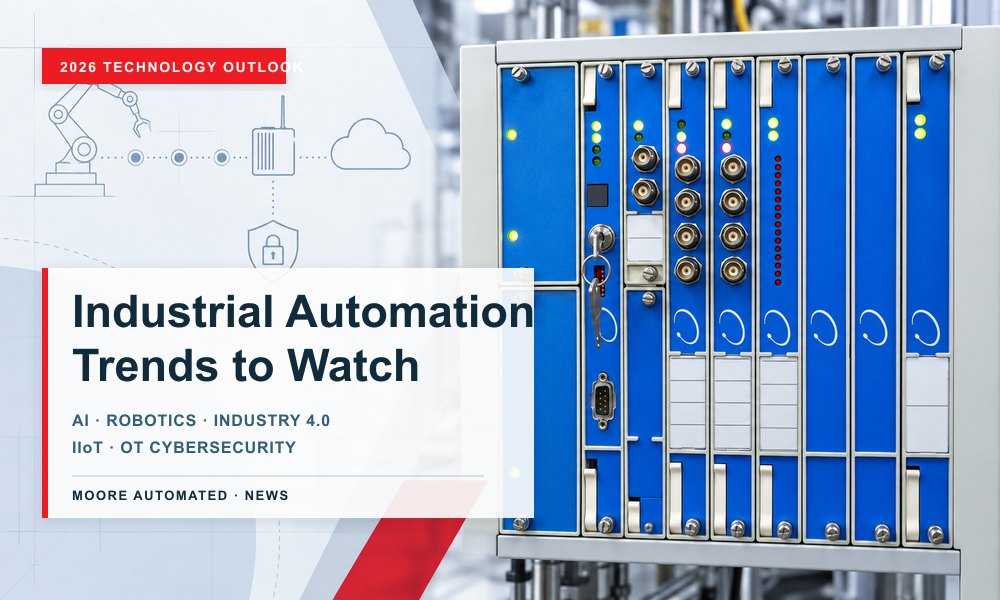
Moore Automated editorial illustration based on an industrial control-system image; the technology-trend graphics are illustrative.
Written by Miya Zheng · Sales Director
Technical review Moore Automated Product Verification Team
Published / reviewed 16 September 2026
2026 technology radar
Five trends, one operational question
AI, industrial robots, Industry 4.0, the Industrial Internet of Things (IIoT) and OT cybersecurity are converging. The practical question is not which label is most fashionable—it is whether the plant can turn trusted data into a safe, supportable decision.
This guide separates the five trends, shows where they connect and sets out the evidence an engineering or procurement team should request before moving from a pilot to an operating asset.
542,076 industrial robots installed worldwide in 2024, according to World Robotics 2025.
5 layers connect, contextualise, decide, control and govern.
1 rule no technology claim replaces model, revision, interface and safety verification.
Trend map
What is changing in industrial automation?
01 / AI
AI-assisted operations
AI is moving from dashboards towards anomaly review, maintenance prioritisation and engineering support. Value depends on labelled, time-aligned data and clear human approval limits.
Evidence: data quality
02 / ROBOTICS
Flexible robot cells
Robot adoption continues, while vision, sensing and easier changeovers extend use beyond fixed high-volume lines. Every application still needs task-specific integration and risk assessment.
Evidence: assessment
03 / INDUSTRY 4.0
Connected production
Industry 4.0 is the operating model that links assets, production context and business workflows. It is broader than buying a connected device or adding a cloud dashboard.
Evidence: information model
04 / IIoT
Edge-to-cloud data
IIoT connects sensors, controllers, gateways and software. Open information models can reduce integration friction, but latency, ownership and lifecycle requirements must be defined first.
Evidence: interface
05 / OT SECURITY
Security by design
Connected assets increase operational visibility and the attack surface. Segmentation, identity, backups, change control and monitored remote access must be designed around safety and availability.
Evidence: risk controls
Reference path
Build the stack from evidence—not from buzzwords
01 · CONNECT
Acquire
Identify exact assets, interfaces, signals, protocols and update rates.
02 · CONTEXTUALISE
Explain
Add units, timestamps, operating states, asset hierarchy and quality flags.
03 · DECIDE
Analyse
Use rules, analytics or AI with a defined owner, confidence threshold and escalation route.
04 · CONTROL
Act
Keep safety, interlocks, approvals and fail-safe behaviour within the engineered control boundary.
05 · GOVERN
Sustain
Manage identity, patches, backups, logs, suppliers and end-of-life risk across the lifecycle.
Adoption gates
A practical 90-day evaluation
Days 1–30: define the decision
Choose one measurable constraint, such as unplanned stops, inspection effort or changeover time.
Record the installed model, hardware revision, firmware, network interfaces and safety function.
Set a baseline and name the engineering owner who can accept or reject the result.
Days 31–60: test the evidence chain
Validate timestamps, missing data, units, failure labels and asset identity.
Separate monitoring from closed-loop control; define where human approval is required.
Review remote access, segmentation, accounts, recovery and supplier support.
Days 61–90: prove supportability
Run the pilot through normal, degraded and recovery conditions.
Document configuration, spares, backups, training and rollback steps.
Approve scale-up only when the performance benefit and operating burden are both visible.
Procurement checkpoint
Request the complete part number, nameplate photo, quantity and required delivery date.
Confirm whether the requirement is a like-for-like spare, migration component or new design.
Verify compatibility against the manufacturer documentation for the exact installed system.
Hardware context
Digital strategies rely on verified physical assets
This recent Moore Automated product video presents a Bently Nevada 3500/93 display interface module. It provides a practical hardware reference alongside the article's wider discussion of connected monitoring, lifecycle support and evidence-led procurement.
Video context: this product presentation supports visual identification only. It does not establish compatibility, condition, firmware, AI capability, cybersecurity status or suitability for a specific installed system.
Representative product routes
From sensing to control and condition monitoring
These pages provide representative routes into control, networking, robotics and machinery-protection hardware. They are not a pre-approved architecture. Confirm the full catalog number, revision, firmware, accessories and system compatibility before ordering.
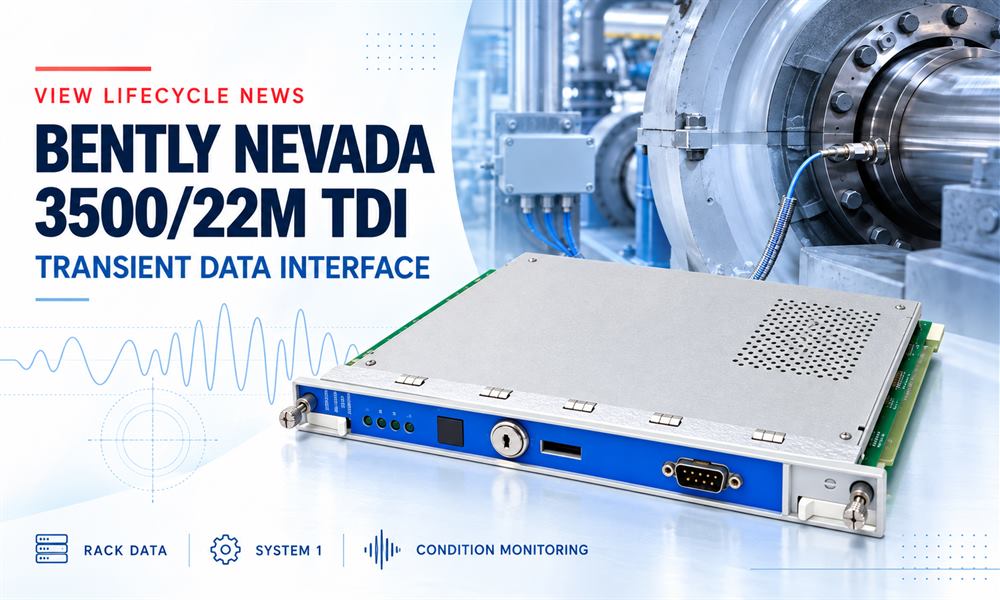
Robotics ABB 3HAB8413-1 Review the exact robot-system application and revision before replacement. Control ABB PM866AK01 / 3BSE076939R1 Controller selection depends on installed AC 800M system requirements. Industrial network Honeywell CC-INWM01 Confirm the complete Experion configuration and network role. Condition monitoring Bently Nevada 3500/22M 138607-01 Verify rack, firmware and interface requirements for the installed system.
Related field cases
Verification before installation
Siemens Middle Eastern client inspection in China How in-person review supported product verification before delivery. Bently Nevada Hardware verification before deployment An Indonesian partner reviewed 3500-series hardware before use. ABB Verification before international delivery A Sudan customer reviewed ABB hardware before shipment.
Why these cases matter Traceability closes the gap Digital transformation does not remove the need to match the physical item, revision and evidence to the planned application.
Information sources
Primary guidance used
Source names are provided as editorial references without third-party links. Project decisions should use the current official edition and exact manufacturer documentation.
International Federation of Robotics — World Robotics 2025
Industrial robot installation and operational-stock statistics.
NIST Cybersecurity Framework 2.0 and NIST SP 800-82 Revision 3
Cybersecurity risk management and operational technology security considerations.
ISA/IEC 62443 series
Lifecycle and shared-responsibility framework for industrial automation and control system security.
ISO 10218-1:2025 and ISO 10218-2:2025
Industrial robot and robot-application safety requirements.
OPC Foundation — OPC UA and Cloud Initiative materials
Interoperable information models and industrial data exchange from field to edge and cloud.
Manufacturer manuals and product documentation
Exact model, revision, firmware, interface, installation and safety requirements.
Author Miya Zheng, Sales Director
Technical review Moore Automated Product Verification Team
Published / reviewed 16 September 2026
Visible FAQ
Industrial automation trends FAQ
View all FAQs
Which industrial automation trend should a plant prioritise first?
Start with the operational constraint, not the technology label. Define the decision, baseline, asset boundary and owner. AI, robotics or IIoT should be selected only if it improves that defined outcome without creating an unacceptable safety, cybersecurity or support burden.
Can AI directly control a safety-critical process?
An AI result should not be treated as a substitute for an engineered safety function. Any control use requires application-specific validation, defined authority limits, fail-safe behaviour, change control and compliance with the relevant functional-safety and machinery requirements.
What is the difference between IIoT and Industry 4.0?
IIoT focuses on connected industrial devices and data exchange. Industry 4.0 is a wider operating model that combines connected assets, contextualised information, automation and business processes. An IIoT gateway can be part of an Industry 4.0 programme, but it is not the whole programme.
Do collaborative robots remove the need for a risk assessment?
No. A robot application must be assessed as an integrated task and cell, including the tool, workpiece, speed, force, access, layout and foreseeable human interaction. The robot's collaborative features alone do not establish that the complete application is safe.
What makes industrial data ready for analytics or AI?
Useful data needs reliable timestamps, engineering units, asset identity, operating-state context, quality flags, sufficient history and labelled events. Teams should also document missing data, sensor changes and maintenance activity that could alter the interpretation.
What should I send with an industrial automation parts inquiry?
Send the manufacturer, complete part number, hardware or series revision, quantity, condition requirement, destination and required date. Nameplate and connector photographs, firmware details and the installed-system context help reduce identification and compatibility errors.
Article-specific inquiry
Need parts for a connected control, robotics or monitoring system?
Share the exact part number, revision, quantity and application context. Moore Automated can review product identity and current sourcing information; final engineering suitability remains subject to the installed system and manufacturer documentation.
Start a trend-guide inquiry Email the requirement
Editorial note: This article provides general technical and procurement context. It does not certify compatibility, cybersecurity, safety performance or regulatory compliance for a specific installation. Always verify the current official documentation and complete system requirements before selection, configuration or use.
{"@context":"https://schema.org","@type":"FAQPage","mainEntity":[{"@type":"Question","name":"Which industrial automation trend should a plant prioritise first?","acceptedAnswer":{"@type":"Answer","text":"Start with the operational constraint, baseline, asset boundary and owner. Select AI, robotics or IIoT only when it improves the defined outcome without creating an unacceptable safety, cybersecurity or support burden."}},{"@type":"Question","name":"Can AI directly control a safety-critical process?","acceptedAnswer":{"@type":"Answer","text":"An AI result is not a substitute for an engineered safety function. Control use requires application-specific validation, authority limits, fail-safe behaviour, change control and relevant compliance review."}},{"@type":"Question","name":"What is the difference between IIoT and Industry 4.0?","acceptedAnswer":{"@type":"Answer","text":"IIoT focuses on connected industrial devices and data exchange. Industry 4.0 is the wider operating model combining connected assets, contextualised information, automation and business processes."}},{"@type":"Question","name":"Do collaborative robots remove the need for a risk assessment?","acceptedAnswer":{"@type":"Answer","text":"No. The integrated task and cell must be assessed, including the tool, workpiece, speed, force, access, layout and foreseeable human interaction."}},{"@type":"Question","name":"What makes industrial data ready for analytics or AI?","acceptedAnswer":{"@type":"Answer","text":"Useful data needs reliable timestamps, engineering units, asset identity, operating-state context, quality flags, sufficient history and labelled events."}},{"@type":"Question","name":"What should I send with an industrial automation parts inquiry?","acceptedAnswer":{"@type":"Answer","text":"Send the manufacturer, complete part number, hardware or series revision, quantity, condition requirement, destination and required date. Include nameplate and connector photographs where possible."}}]}