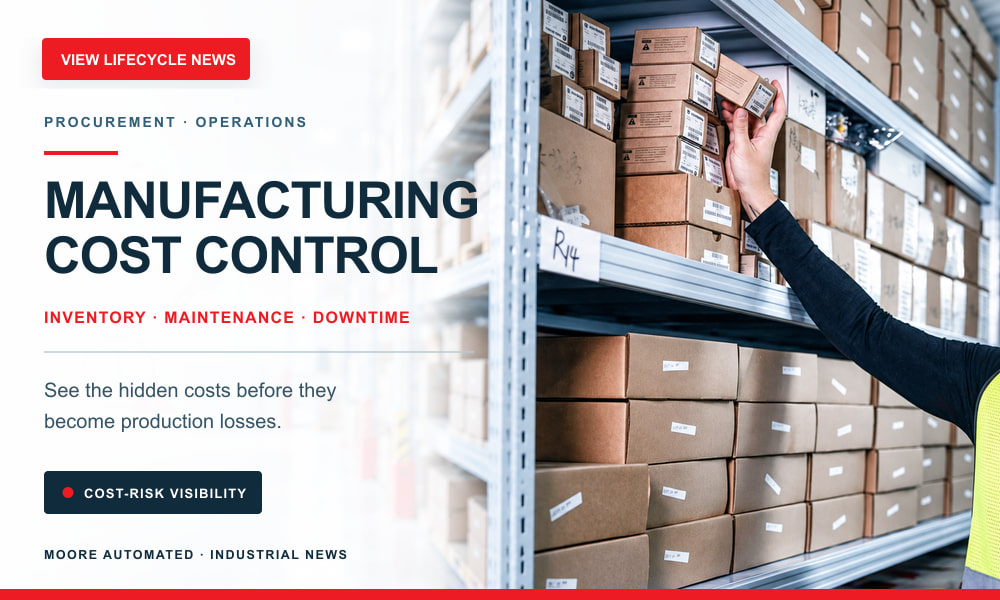
Manufacturing Cost Control: Inventory, Maintenance and Downtime
Executive guide · manufacturing cost management
Control the costs that never appear on the purchase order
Manufacturing cost management is not simply a search for the lowest component price. Procurement and operations teams also need visibility into inventory carrying cost, maintenance timing, obsolescence exposure, wrong-part risk and the production impact of delayed recovery.
This guide presents a practical decision framework for industrial automation spares. It helps teams compare what it costs to hold a critical spare with what it could cost to wait for a failure, source the wrong revision or accept an unrealistic lead time.
Published: September 22, 2026 Author: Miya Zheng, Sales Director at Moore Automated Technical review: Moore Automated Product Verification Team Reviewed: September 22, 2026
Inventory, maintenance timing, downtime exposure and procurement evidence belong in one cost decision. The cost iceberg
Four cost pools belong in one decision
01 / STOCK Inventory exposure
Capital tied up, storage, ageing, preservation and the chance that a stocked item no longer matches the installed base.
02 / CARE Maintenance cost
Labour, planned shutdown access, test equipment, repair scope and the evidence required to return an asset to service.
03 / LOSS Downtime impact
Lost throughput, idle labour, recovery sequencing, quality losses and expedited logistics during an interruption.
04 / ERROR Procurement risk
Wrong suffixes, incomplete revisions, unsuitable condition, uncertain lead times and unverified substitution.
Decision lens—not an accounting formula Total cost exposure = carrying cost + planned maintenance cost + expected downtime impact + procurement and lifecycle risk. Use evidence-based ranges and local operating data; do not treat a generic industry figure as a guaranteed saving.
Total cost view
Why unit price is only one line in the cost model
A low quoted price can still produce a high total cost when the part number is incomplete, the condition is unclear, documentation is missing or the delivery window does not match the shutdown plan.
Before comparing offers, standardise the evidence requested from every supplier: complete manufacturer part number, suffixes, stated condition, quantity, test or inspection scope, written lead time, warranty terms and delivery destination.
Verification before comparison Visible labels and exact identifiers help procurement compare like with like before price becomes the deciding factor.
Cost signal
Evidence to request
Decision question
Price variance
Condition, inclusions, warranty and freight basis
Are the quotations genuinely comparable?
Lead-time risk
Stock status, dispatch point and written availability
Does the date protect the maintenance window?
Wrong-part risk
Full part number, suffix, revision and nameplate image
Has the exact installed requirement been matched?
Lifecycle risk
OEM notices, installed-base data and migration status
Should the team stock, repair or plan replacement?
Stock with a defined purpose Storage space and tied-up capital should protect a documented production risk—not simply accumulate available parts.
Inventory strategy
Stock by consequence, not by habit
Critical-spares planning should connect the probability of failure with the consequence of waiting. A rarely used module may still deserve protection if it can stop a bottleneck asset and has a long or uncertain replacement route.
Conversely, buying every available obsolete part can create stranded stock. Review installed quantity, commonality across lines, historical consumption, shelf-life or preservation needs, repair options, substitution constraints and migration timing.
IAS 2 provides the accounting framework for inventory cost and write-downs. Operational teams still need an engineering view of why a spare is held and what risk it is intended to control.
High criticality / long lead time Protect availability
Consider a verified strategic spare, preservation plan and defined reorder trigger.
High criticality / short lead time Validate the route
Confirm supplier capacity and emergency logistics rather than assuming immediate supply.
Low criticality / long lead time Plan selectively
Use commonality, repairability and installed quantity to decide whether holding stock is justified.
Low criticality / short lead time Avoid excess
Buy against a clear requirement and monitor lifecycle changes without automatically increasing stock.
Maintenance budgeting
Budget around failure modes and decision windows
Reactive work is increasing Separate emergency purchases, expedited freight and repeat call-outs from routine maintenance spend.
Planned work is repeatedly deferred Record whether access, parts, labour, approvals or technical information caused the delay.
Critical modules are ageing Track lifecycle status and lead-time changes before the installed base forces a crisis decision.
Failure data lacks context Link work orders to asset, mode, part number, revision, production effect and corrective action.
A NIST manufacturing study reported that establishments relying heavily on reactive maintenance were associated with materially higher downtime, defects, lost sales and maintenance-related inventory increases. The practical lesson is not that one maintenance method fits every asset; it is that the mix should be deliberate, measured and aligned to consequence.
Product identification in practice
Exact module identification is a cost-control step
The short Moore Automated video below shows an ICS Triplex T8431 analogue input module. A product video does not prove application compatibility, but it can support the evidence package used to confirm physical identity, visible condition and the precise item being discussed.
Video context: product footage supports visual identification only. Final suitability depends on the complete part number, system requirements, agreed condition and written quotation.
Cross-functional workflow
Turn a spare-parts request into a cost decision
01 / DEFINE Describe the exposure
Asset, failure mode, production consequence, required date and acceptable operating alternatives.
02 / VERIFY Lock the identity
Manufacturer, full part number, suffix, revision, quantity and installed-system context.
03 / COMPARE Normalise the offers
Condition, evidence, warranty, lead time, logistics basis and technical exclusions.
04 / RECORD Keep the rationale
Document why the item was stocked, repaired, expedited, deferred or included in a migration plan.
Related product routes
Components commonly included in critical-spares reviews
PLC & I/O PLC CPUs, I/O and communication modules Review exact part numbers, installed architecture and lifecycle status before quoting. Allen-Bradley Control and drive spares Support for current, surplus and hard-to-find automation requirements. Siemens SIMATIC and industrial automation parts Confirm series, order number and suffix before comparing availability. Bently Nevada Machinery monitoring components Plan monitoring-system spares around exact models and maintenance requirements.
Related success stories
Evidence before commitment
Malaysia · Bently Nevada On-site batch inspection before the next procurement step See how visible model, part-number, packaging and condition checks supported a clearer decision. Indonesia · Bently Nevada Hardware verification before deployment A practical example of reducing ambiguity around a critical monitoring-system requirement.
Information sources
Guidance used for this article
Source names are presented as plain text. No third-party hyperlinks are embedded in this section.
U.S. Department of Energy — Operations and Maintenance Best Practices: A Guide to Achieving Operational Efficiency.
National Institute of Standards and Technology — Research on the manufacturing impact of advanced machinery maintenance.
ISO 55000:2024 — Asset management vocabulary, overview and principles.
IFRS Foundation, IAS 2 Inventories — Inventory cost, measurement and write-down principles.
Moore Automated operational guidance — Part-number verification, condition disclosure and written quotation practices.
Article-specific enquiry
Build a cost-aware critical-spares plan
Send the manufacturer, complete part number, quantity, destination, required date and the asset consequence you are trying to control. Moore Automated can confirm available product information, stated condition, lead time and applicable warranty in writing.
Request a cost-aware parts review Open the enquiry form
Visible FAQ
Manufacturing cost management FAQ
How should a manufacturer estimate downtime cost?
Use a documented range based on the affected production rate, contribution margin, idle labour, quality loss, restart requirements, contractual exposure and recovery time. Separate known data from assumptions and avoid presenting a generic industry average as a guaranteed site-specific loss.
When is it reasonable to hold an obsolete automation spare?
It may be reasonable when the part supports a critical asset, failure consequence is high, replacement lead time is long or uncertain, and compatibility has been verified. The decision should also consider preservation, shelf life, repairability, migration timing and the risk of stranded inventory.
How can procurement compare quotations fairly?
Ask every supplier to state the complete part number, suffix, revision where applicable, product condition, quantity, inspection or test scope, dispatch status, lead time, freight basis, warranty and exclusions. Unit prices should be compared only after these fields are aligned.
Does a product video prove that a module is compatible?
No. A video may support visible identification, but compatibility depends on the complete manufacturer part number, installed architecture, firmware or revision requirements, application data and engineering approval where required.
What information helps Moore Automated prepare a quotation?
Provide the manufacturer, complete part number, all suffixes, quantity, preferred condition, destination country, required date and a clear nameplate photograph if available. Sharing the installed system or planned maintenance window can reduce clarification cycles.
Can Moore Automated confirm delivery and warranty before purchase?
Availability, lead time, stated condition and applicable warranty should be confirmed in the written quotation for the specific item. Dispatch timing depends on confirmed stock, order processing, destination and the selected logistics service.
View all Moore Automated FAQs →
{
"@context":"https://schema.org",
"@type":"FAQPage",
"mainEntity":[
{"@type":"Question","name":"How should a manufacturer estimate downtime cost?","acceptedAnswer":{"@type":"Answer","text":"Use a documented range based on the affected production rate, contribution margin, idle labour, quality loss, restart requirements, contractual exposure and recovery time. Separate known data from assumptions."}},
{"@type":"Question","name":"When is it reasonable to hold an obsolete automation spare?","acceptedAnswer":{"@type":"Answer","text":"It may be reasonable when the part supports a critical asset, failure consequence is high, replacement lead time is long or uncertain, and compatibility has been verified. Also consider preservation, repairability and migration timing."}},
{"@type":"Question","name":"How can procurement compare quotations fairly?","acceptedAnswer":{"@type":"Answer","text":"Align the complete part number, suffix, revision, condition, quantity, test scope, dispatch status, lead time, freight basis, warranty and exclusions before comparing unit prices."}},
{"@type":"Question","name":"Does a product video prove that a module is compatible?","acceptedAnswer":{"@type":"Answer","text":"No. A video may support visible identification, but compatibility depends on the complete manufacturer part number, installed architecture and application requirements."}},
{"@type":"Question","name":"What information helps Moore Automated prepare a quotation?","acceptedAnswer":{"@type":"Answer","text":"Provide the manufacturer, complete part number, suffixes, quantity, preferred condition, destination, required date and a nameplate photograph if available."}},
{"@type":"Question","name":"Can Moore Automated confirm delivery and warranty before purchase?","acceptedAnswer":{"@type":"Answer","text":"Availability, lead time, stated condition and applicable warranty should be confirmed in the written quotation for the specific item."}}
]
}
.mcc{--navy:#102f43;--blue:#315f78;--red:#ed1c24;--ink:#18313f;--muted:#58707d;--line:#d8e3e9;--soft:#f3f7f9;--white:#fff;font-family:Arial,Helvetica,sans-serif;color:var(--ink);line-height:1.72;max-width:100%;overflow:hidden}
.mcc *{box-sizing:border-box}.mcc a{color:inherit}.mcc h2,.mcc h3{color:var(--navy);font-weight:750;letter-spacing:-.025em}.mcc h2{font-size:34px;line-height:1.18;margin:0 0 18px}.mcc h3{font-size:20px;line-height:1.35;margin:0 0 10px}.mcc p{font-size:16px;color:#344f5e;margin:0 0 16px}.mcc .eyebrow{display:block;margin-bottom:13px;color:var(--red);font-size:11px;font-weight:800;letter-spacing:2px;text-transform:uppercase}.mcc .section{padding:44px 0;border-bottom:1px solid var(--line)}
.mcc .intro{padding:24px 0 38px}.mcc .lede{max-width:850px;font-size:20px;line-height:1.62;color:#274657}.mcc .reviewbar{display:flex;flex-wrap:wrap;gap:10px 28px;margin-top:24px;padding:17px 20px;border-left:4px solid var(--red);background:var(--soft);font-size:13px;color:#486270}.mcc .reviewbar strong{color:var(--navy)}
.mcc .cost-strip{display:grid;grid-template-columns:repeat(4,minmax(0,1fr));border:1px solid var(--line);background:#fff}.mcc .cost-item{position:relative;padding:26px 22px 24px;border-right:1px solid var(--line)}.mcc .cost-item:last-child{border-right:0}.mcc .cost-item small{display:block;color:#8aa0ad;font-size:10px;font-weight:800;letter-spacing:1.6px}.mcc .cost-item strong{display:block;margin:12px 0 7px;color:var(--navy);font-size:19px;line-height:1.28}.mcc .cost-item p{font-size:13px;line-height:1.6;margin:0}.mcc .cost-item:before{content:"";position:absolute;left:22px;top:0;width:38px;height:3px;background:var(--red)}
.mcc .formula{margin-top:24px;padding:22px 24px;background:var(--navy);color:#fff}.mcc .formula strong{display:block;margin-bottom:7px;font-size:12px;letter-spacing:1.5px;text-transform:uppercase;color:#f1b4b6}.mcc .formula span{font-size:17px;line-height:1.55}.mcc .formula em{display:block;margin-top:8px;font-size:12px;color:#bcd0dc;font-style:normal}
.mcc .two-col{display:grid;grid-template-columns:minmax(0,.92fr) minmax(0,1.08fr);gap:36px;align-items:start}.mcc .decision-table{width:100%;border-collapse:collapse;background:#fff;border:1px solid var(--line)}.mcc .decision-table th,.mcc .decision-table td{text-align:left;vertical-align:top;padding:15px 16px;border-bottom:1px solid var(--line);font-size:13px;line-height:1.55}.mcc .decision-table th{background:var(--navy);color:#fff;font-size:11px;letter-spacing:.7px;text-transform:uppercase}.mcc .decision-table tr:last-child td{border-bottom:0}.mcc .decision-table td:first-child{font-weight:700;color:var(--navy)}
.mcc .risk-map{display:grid;grid-template-columns:1fr 1fr;border:1px solid var(--line)}.mcc .risk-cell{min-height:170px;padding:22px;border-right:1px solid var(--line);border-bottom:1px solid var(--line)}.mcc .risk-cell:nth-child(2n){border-right:0}.mcc .risk-cell:nth-last-child(-n+2){border-bottom:0}.mcc .risk-cell b{display:block;color:var(--navy);font-size:18px}.mcc .risk-cell span{display:block;margin:7px 0 11px;color:var(--red);font-size:11px;font-weight:800;letter-spacing:1.2px;text-transform:uppercase}.mcc .risk-cell p{font-size:13px;margin:0}.mcc .risk-cell.priority{background:#fff7f7}.mcc .risk-cell.control{background:#f3f8fb}
.mcc .signal-list{display:grid;grid-template-columns:1fr 1fr;gap:14px}.mcc .signal{padding:18px;border:1px solid var(--line);background:#fff}.mcc .signal b{display:block;color:var(--navy);font-size:15px}.mcc .signal span{display:block;margin-top:5px;color:var(--muted);font-size:13px;line-height:1.55}
.mcc .video-block{padding:44px 0}.mcc .video-head{max-width:820px;margin-bottom:22px}.mcc .video-wrap{position:relative;overflow:hidden;width:100%;padding-top:56.25%;background:#0d2535}.mcc .video-wrap iframe{position:absolute;inset:0;width:100%;height:100%;border:0}.mcc .video-note{margin:13px 0 0;padding:13px 16px;border:1px solid var(--line);background:#f8fafb;font-size:12px;color:#667c88}
.mcc .workflow{display:grid;grid-template-columns:repeat(4,minmax(0,1fr));gap:0;border-top:1px solid var(--line);border-bottom:1px solid var(--line)}.mcc .step{padding:24px 20px;border-right:1px solid var(--line)}.mcc .step:last-child{border-right:0}.mcc .step small{color:var(--red);font-size:11px;font-weight:800;letter-spacing:1.4px}.mcc .step b{display:block;margin:8px 0;color:var(--navy);font-size:17px}.mcc .step p{margin:0;font-size:13px}
.mcc .card-grid{display:grid;grid-template-columns:repeat(2,minmax(0,1fr));gap:14px}.mcc .link-card{display:block;min-height:148px;padding:22px;border:1px solid var(--line);background:#fff;text-decoration:none!important;transition:border-color .2s,transform .2s}.mcc .link-card:hover{border-color:var(--red);transform:translateY(-2px)}.mcc .link-card small{display:block;color:var(--red);font-size:10px;font-weight:800;letter-spacing:1.4px;text-transform:uppercase}.mcc .link-card strong{display:block;margin:9px 0 7px;color:var(--navy);font-size:18px;line-height:1.35}.mcc .link-card span{color:var(--muted);font-size:13px;line-height:1.5}
.mcc .source-box{display:grid;grid-template-columns:.75fr 1.25fr;border:1px solid var(--line);background:var(--soft)}.mcc .source-intro{padding:26px;border-right:1px solid var(--line)}.mcc .source-list{margin:0;padding:20px 28px 20px 48px}.mcc .source-list li{padding:9px 0;color:#385565;font-size:14px;border-bottom:1px solid #d4e0e6}.mcc .source-list li:last-child{border-bottom:0}.mcc .source-list strong{color:var(--navy)}
.mcc .quote{padding:34px;background:linear-gradient(125deg,#102f43,#214f68);color:#fff}.mcc .quote h2,.mcc .quote p{color:#fff}.mcc .quote p{max-width:720px;color:#dce9ef}.mcc .quote-actions{display:flex;flex-wrap:wrap;gap:12px;margin-top:22px}.mcc .btn{display:inline-flex;align-items:center;justify-content:center;min-height:48px;padding:12px 19px;border:1px solid #fff;background:#fff;color:var(--navy)!important;text-decoration:none!important;font-size:13px;font-weight:800}.mcc .btn.primary{border-color:var(--red);background:var(--red);color:#fff!important}
.mcc .faq details{border-top:1px solid var(--line)}.mcc .faq details:last-child{border-bottom:1px solid var(--line)}.mcc .faq summary{cursor:pointer;list-style:none;padding:20px 42px 20px 0;color:var(--navy);font-size:16px;font-weight:750;position:relative}.mcc .faq summary::-webkit-details-marker{display:none}.mcc .faq summary:after{content:"+";position:absolute;right:8px;top:15px;color:var(--red);font-size:25px}.mcc .faq details[open] summary:after{content:"−"}.mcc .faq details p{padding:0 36px 18px 0;font-size:14px}
@media(max-width:800px){.mcc h2{font-size:28px}.mcc .section,.mcc .video-block{padding:34px 0}.mcc .cost-strip,.mcc .workflow{grid-template-columns:1fr 1fr}.mcc .cost-item:nth-child(2),.mcc .step:nth-child(2){border-right:0}.mcc .cost-item:nth-child(-n+2),.mcc .step:nth-child(-n+2){border-bottom:1px solid var(--line)}.mcc .two-col{grid-template-columns:1fr}.mcc .source-box{grid-template-columns:1fr}.mcc .source-intro{border-right:0;border-bottom:1px solid var(--line)}}
@media(max-width:520px){.mcc .lede{font-size:18px}.mcc .cost-strip,.mcc .workflow,.mcc .risk-map,.mcc .signal-list,.mcc .card-grid{grid-template-columns:1fr}.mcc .cost-item,.mcc .step,.mcc .risk-cell{border-right:0!important;border-bottom:1px solid var(--line)!important}.mcc .cost-item:last-child,.mcc .step:last-child,.mcc .risk-cell:last-child{border-bottom:0!important}.mcc .quote{padding:26px 20px}.mcc .btn{width:100%}.mcc .source-list{padding-left:38px}}
@media(prefers-reduced-motion:reduce){.mcc .link-card{transition:none}}
/* Clear, image-led article layout */
.mcc{background:#edf3f6;padding:22px;overflow:visible}
.mcc .intro,.mcc .section,.mcc .video-block{position:relative;margin:0 0 26px;padding:38px;background:#fff;border:1px solid var(--line);box-shadow:0 12px 28px rgba(16,47,67,.06)}
.mcc .intro:before,.mcc .section:before,.mcc .video-block:before{content:"";position:absolute;left:-1px;top:-1px;width:74px;height:4px;background:var(--red)}
.mcc .intro{padding-bottom:32px}.mcc .intro-copy{max-width:860px}.mcc .media-hero{margin:30px 0 0;border:1px solid var(--line);background:#fff}.mcc .media-hero img{display:block;width:100%;height:auto}.mcc figcaption{padding:14px 16px;border-top:1px solid var(--line);background:#f7fafb;color:#526c7a;font-size:12px;line-height:1.55}.mcc figcaption strong,.mcc figcaption span{display:block}.mcc figcaption strong{margin-bottom:4px;color:var(--navy);font-size:13px}
.mcc .section-head{max-width:820px;margin-bottom:26px}.mcc .evidence-layout{display:grid;grid-template-columns:minmax(210px,.68fr) minmax(0,1.32fr);gap:26px;align-items:stretch}.mcc .photo-card{margin:0;border:1px solid var(--line);background:#fff;display:flex;flex-direction:column}.mcc .photo-card img{display:block;width:100%;height:100%;min-height:280px;object-fit:cover}.mcc .photo-card figcaption{margin-top:auto}.mcc .inventory-feature{display:grid;grid-template-columns:minmax(280px,.9fr) minmax(0,1.1fr);gap:30px;align-items:stretch;margin-bottom:28px}.mcc .photo-card.wide img{min-height:300px}.mcc .inventory-copy{padding:6px 0}
.mcc .cost-strip{box-shadow:0 8px 22px rgba(16,47,67,.05)}.mcc .cost-item:nth-child(odd){background:#f8fbfc}.mcc .formula{margin-top:20px}.mcc .decision-table{box-shadow:0 8px 22px rgba(16,47,67,.05)}.mcc .risk-map{box-shadow:0 8px 22px rgba(16,47,67,.05)}.mcc .risk-cell{background:#fff}.mcc .signal-list{gap:18px}.mcc .signal{padding:22px;background:#f8fbfc;border-left:4px solid var(--blue);box-shadow:0 6px 18px rgba(16,47,67,.04)}
.mcc .video-block{padding:38px}.mcc .video-wrap{box-shadow:0 12px 28px rgba(16,47,67,.12)}.mcc .workflow{border:1px solid var(--line);box-shadow:0 8px 22px rgba(16,47,67,.05)}.mcc .step:nth-child(odd){background:#f8fbfc}.mcc .card-grid{gap:18px}.mcc .link-card{background:#f8fbfc;border-left:4px solid var(--blue);box-shadow:0 6px 18px rgba(16,47,67,.04)}
.mcc .section.source-box{padding:0;display:grid;background:#fff}.mcc .section.source-box:before{z-index:2}.mcc .section.quote{border:0;background:linear-gradient(125deg,#102f43,#214f68)}.mcc .section.quote:before{background:#fff}.mcc .faq details{margin:0 0 10px;padding:0 18px;border:1px solid var(--line)!important;background:#f8fbfc}.mcc .faq summary{padding-right:42px}
@media(max-width:800px){.mcc{padding:14px}.mcc .intro,.mcc .section,.mcc .video-block{padding:28px 24px}.mcc .evidence-layout,.mcc .inventory-feature{grid-template-columns:1fr}.mcc .photo-card img,.mcc .photo-card.wide img{height:auto;min-height:0}.mcc .section.source-box{padding:0}}
@media(max-width:520px){.mcc{padding:8px}.mcc .intro,.mcc .section,.mcc .video-block{padding:24px 18px;margin-bottom:18px}.mcc .media-hero{margin-top:22px}.mcc .evidence-layout,.mcc .inventory-feature{gap:18px}.mcc .faq details{padding:0 14px}}