
MP 3009X
Get A Quote
When a drive fails on a critical line, nobody in the plant asks for a logo; they ask how fast you can get the motor spinning again and how long it will stay that way. ABB drives are a solid benchmark in that conversation, but they are not the only game in town. The global industrial automation market was around $205.9 billion in 2023, with ABB holding about 11% according to analysis summarized by The Brand Hopper, which means there is plenty of room for serious competitors in drives, automation platforms, and the services around them.
This article looks at ABB drive alternatives the way a plant engineer or integrator does: by combining what the major OEMs offer with what distributors, surplus suppliers, and repair houses can realistically deliver under time and budget pressure. The goal is not to knock ABB; in fact, ABB’s own upgrade and retrofit ecosystem is often the starting benchmark. The goal is to show where alternatives such as Yaskawa, Delta, Mitsubishi Electric, Siemens, Rockwell, and a set of specialized suppliers can make practical sense, along with the risks that come with each route.
Before diving into suppliers, it is worth clarifying terminology. A variable frequency drive is an electronic device that controls AC motor speed and torque by varying the input frequency and voltage. That definition, highlighted in Yaskawa-focused material from Excel, frames why drives matter so much: they sit right between the power system and the mechanical load, and they are one of the largest levers for energy efficiency and process stability in pumps, fans, compressors, conveyors, and more.
Any discussion of ABB alternatives should start with what ABB itself brings to the table today, because that often sets the bar for performance and lifecycle expectations.
ABB’s own documentation on upgrades and retrofits for medium-voltage drives emphasizes that modernization does not always mean ripping out cabinets. For the ACS1000, for example, ABB offers a main board upgrade to the AMC34 control platform. This replaces obsolete components, adds new software features, and extends lifecycle support by up to about 10 years while maintaining relatively low CO₂ impact and improving cybersecurity through a modern gateway. For the ACS6000, ABB’s UCU-26 control upgrade, inheriting technology from the ACS6080, adds advanced control such as Model Predictive Pulse Pattern Control on top of Direct Torque Control, reduces motor harmonic losses by up to about 50%, and extends lifecycle support without requiring a cabinet replacement.
For wind and large line-commutated converter systems such as PCS6000 and MEGADRIVE-LCI, ABB’s PEC3 upgrade packages are marketed with tangible performance claims, such as up to roughly 10% increases in production output and up to 10% reductions in CO₂ emissions, plus extended equipment lifetimes. The underlying pattern is clear: ABB leans heavily on engineered retrofit packages to protect existing investments and keep plants on its platform.
On the digital side, ABB positions its software and data layer under ABB Ability and its manufacturing operations management suite. Market overviews from sources like Verified Market Research and The Brand Hopper describe ABB as a leader in robotics and digital automation, but they also emphasize strong competition from Siemens, Schneider Electric, Rockwell Automation, Mitsubishi Electric, Honeywell, and Emerson. That competition plays out not just in PLCs and robots, but also in drives and the platforms that orchestrate them.
From an on-site engineering perspective, this all translates into a simple first question. Before you go hunting for an ABB alternative, can an ABB upgrade, combined with a robust repair strategy, solve your problem faster and more safely than a platform shift? If the answer is no, then it is time to look at alternatives.
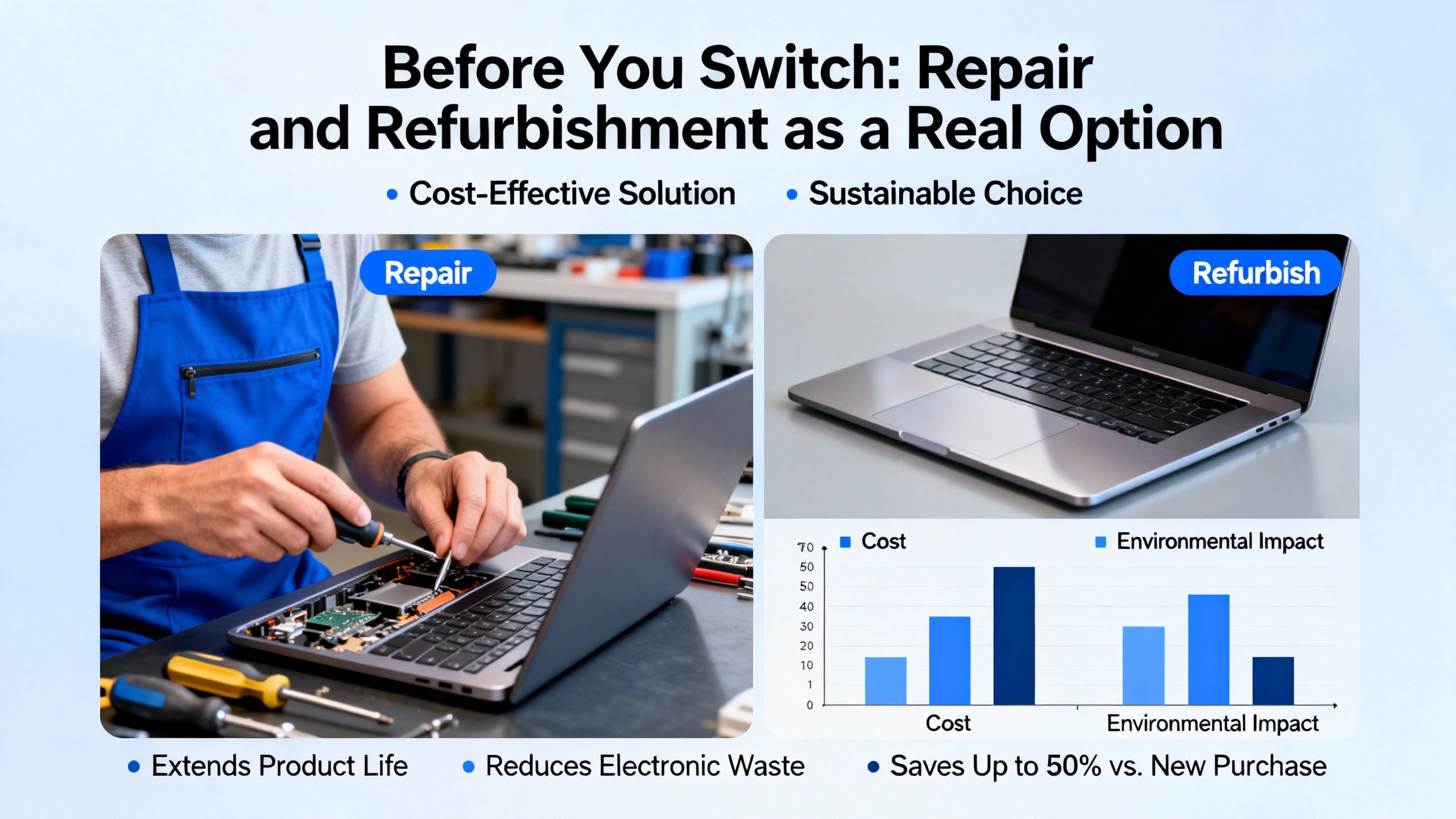
In many plants, the decision is not strictly ABB versus another OEM. It is ABB upgrade versus third-party repair versus outright replacement with a different brand. Third-party repair houses can change the math in favor of staying with ABB hardware, especially when the existing drive is tightly integrated into control cabinets and process safety logic.
Roc Industrial LLC focuses on ABB variable frequency drive repair, testing, and refurbishment. They support a wide range of ABB families, including ACS355, ACS550, ACS580, ACS800, ACS880, ACQ580, ACH580, DCS800, and other standard, machinery, HVAC, and water drives. Their process starts with a free evaluation and quote, then proceeds to component-level repair using specialized diagnostics, followed by load testing under simulated real-world conditions. They highlight 30-plus years of industrial electronics experience, thousands of ABB VFD parts in stock for faster repairs, ISO-certified processes, quick turnaround that can be on the order of a few business days, and a comprehensive warranty with post-repair support.
UpFix takes a repair-and-return approach for specific ABB AC drive models such as the VS1SD2A10-4B. The value proposition is simple: instead of buying a new drive, you send in the failed unit, keep your existing physical footprint and programming, and get a repaired unit back. UpFix emphasizes a repair time around three to five business days after receipt, a two-year warranty, high repair success rate, and a money-back guarantee if the repair fails. They are clear that they are not an authorized ABB distributor and therefore operate as an independent repair provider.
These services show that “alternative supplier” does not always mean “alternative brand.” For many plants, especially those with complex drive parameterization and tightly constrained cabinet layouts, professional refurbishment is a legitimate alternative to both ABB upgrades and brand migration, often at lower cost and with less commissioning effort.
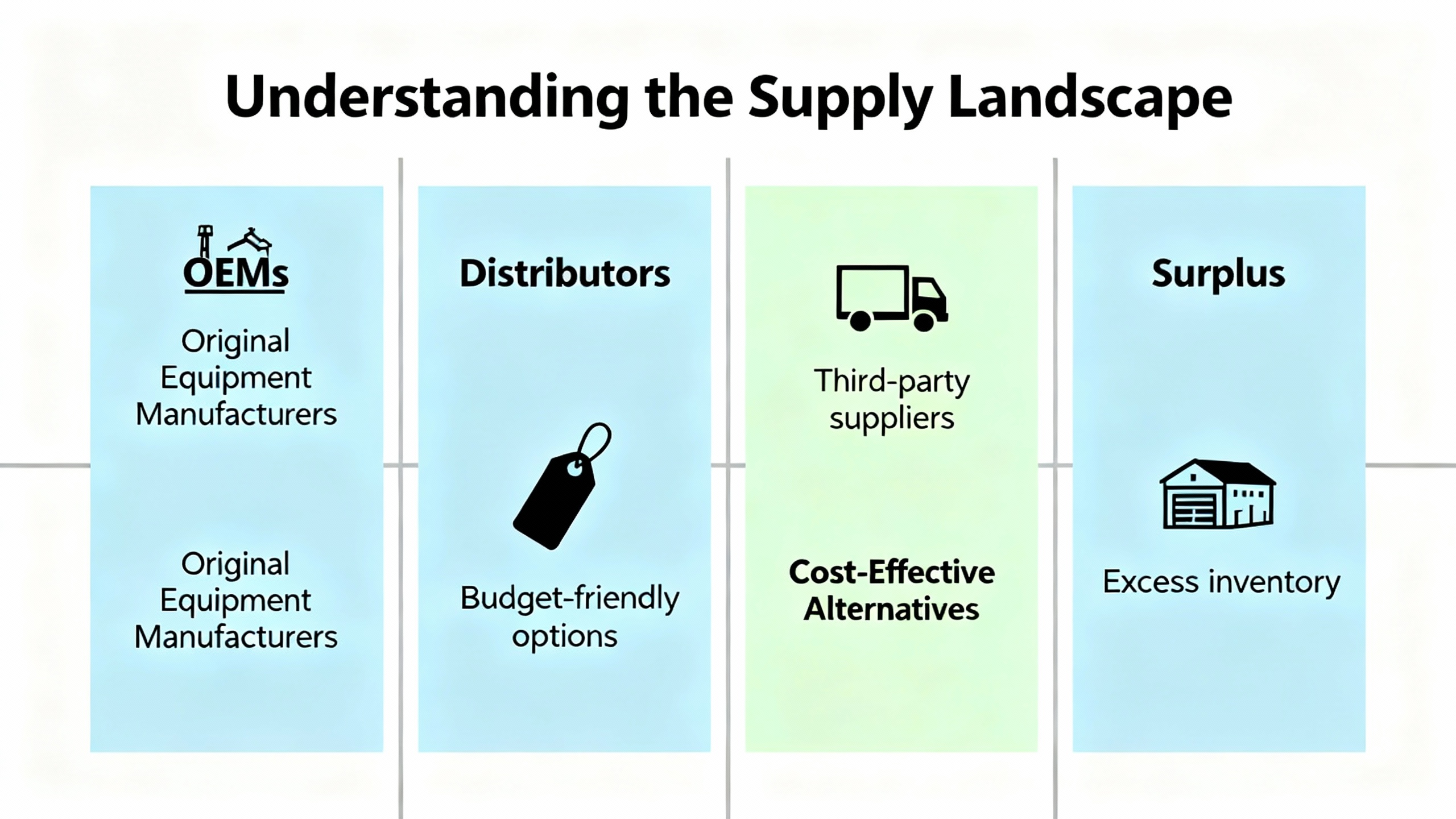
A detailed guide from OMCH on industrial automation parts suppliers lays out a structure that is very useful when planning drive alternatives. It distinguishes four main sourcing channels: global original equipment manufacturers, authorized distributors, cost-effective alternative manufacturers, and surplus or obsolete-parts specialists. Each has a distinct cost profile, delivery speed, and risk pattern.
Global OEMs such as Siemens, Rockwell, ABB, and Mitsubishi Electric provide the technical authority and system-level integration. They are best suited for greenfield projects, global standardization on a single automation ecosystem, and high-volume machine builders with predictable annual consumption. Lead times are longer and costs are higher, but so is the depth of engineering support.
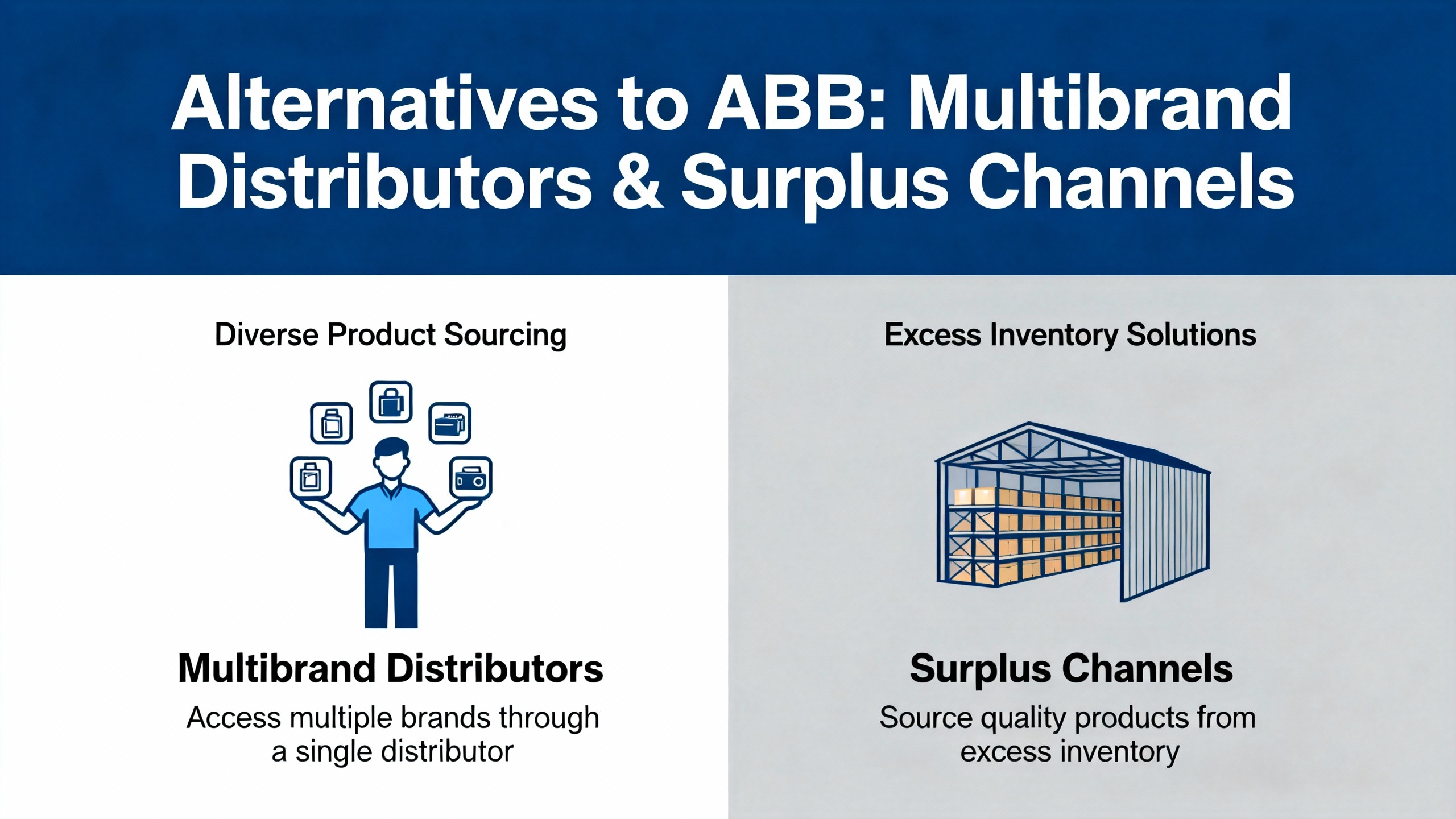
Authorized distributors such as Digi-Key, Wesco, and RS Group act as the bridge between OEMs and users, offering multi-brand catalogs, large inventories, and very fast shipping, including same-day shipment in many cases. They shine in maintenance, repair, and operations scenarios where a sensor, power supply, or smaller drive needs to be in your hands the next morning, and in high-mix, low-volume orders where multiple brands must be combined into one purchase.
Cost-effective alternatives, including manufacturers like Delta and Autonics and OMCH itself, compete on price-to-performance. They tend to ship on medium lead times and offer components that operate similarly to top-tier brands but at lower unit cost. This category is particularly attractive for non-core parts or when budget is tight and the performance envelope is well understood.
Surplus and obsolete-part specialists such as Radwell and the types of firms covered in Classic Automation and Industrial Automation Co material focus on saving “dead” systems by sourcing end-of-life components, often used or refurbished. Delivery can be fast because items are in stock, but quality, documentation, and OEM support are variable and require more engineering scrutiny.
Seen through that lens, “best ABB drive alternative supplier” is not a single name. It is the combination of an OEM platform and one or more channels that match your risk tolerance and time constraints. With that context in place, we can look at specific OEMs that stand out as credible ABB drive alternatives.
Yaskawa is one of the most credible ABB drive alternatives in the North American market, especially for AC motor control. Excel, a factory-authorized integrator, service provider, and distributor for Yaskawa drives, describes Yaskawa America’s Drives and Motion Division as operating under a formal quality policy centered on continual improvement and customer satisfaction. The company explicitly commits to meeting all applicable requirements of interested parties, which in practice means aligning with relevant industry, customer, and regulatory standards.
Yaskawa’s marketing positions its variable frequency drives as a benchmark for reliability. They emphasize never cutting corners on quality, and they promote very long service life as a core value proposition. According to Excel’s characterization, Yaskawa has maintained a quality leadership position for roughly four decades in North America, and its drives are known for dependable operation and low lifecycle costs.
From a practical standpoint, using an authorized Yaskawa partner such as Excel gives you factory-backed product supply along with engineering and service support. For operators in regions like Louisiana, Excel presents itself as a one-stop source for Yaskawa drives at competitive pricing, plus technical help on selection, setup, and troubleshooting. In plants where the priority is long-term reliability of pumps, fans, and process machinery, and where ABB lead times or pricing are problematic, Yaskawa via an authorized channel is often one of the first alternatives to evaluate.
Delta Electronics, profiled in OMCH’s guide as a global leader in power management and green smart manufacturing, positions itself directly as an alternative to top automation brands, including those associated with ABB’s peer group. Delta’s automation product line includes DVP and AS series PLCs, variable frequency drive inverters, and servo drives.
OMCH notes that Delta’s strategy is straightforward: provide products that operate in a very similar way to leading platforms such as Siemens and Mitsubishi, but at more competitive prices. Their drives and servo systems are described as reputable in the market, and they are singled out as a best option for many mid-range OEM machine builders because they blend consistent performance with attractive pricing.
Delta has also been investing in smart manufacturing software and SCADA solutions, moving beyond components toward system-level offerings. This evolution is important if you are looking for more than just a drop-in drive and want to maintain a coherent automation architecture across PLCs, drives, and visualization.
In the field, Delta becomes compelling when a project’s budget is tight, the performance requirements are well understood, and you have integrators or in-house engineers comfortable with Delta’s tools. It is especially suited for new equipment where you control the entire design, rather than as a single-drive replacement inside a standardized ABB environment.
Mitsubishi Electric is another major OEM that can serve as an ABB drive alternative, particularly in Asian markets and in precision manufacturing sectors. The OMCH guide describes Mitsubishi Electric as a top brand in factory automation with core focus areas in factory automation and mechatronics, and lists its FREQROL inverters alongside MELSEC PLCs and MELSERVO systems.
Mitsubishi Electric is associated with a “Zero Failure” quality philosophy, characterized by precision, compact design, and strong durability. Its small FX series PLCs are among the highest-selling controllers worldwide, and its servo systems lead in areas such as semiconductor manufacturing, electronics assembly, and battery production equipment. For drives, the FREQROL line fits well into this ecosystem, especially when coupled with the company’s e-F@ctory concept, which focuses on solving issues at the production location using edge computing rather than relying solely on cloud platforms.
In practice, Mitsubishi becomes a strong ABB alternative in electronics manufacturing, packaging machinery, and small to medium equipment where space is at a premium and long-term reliability is critical. Its ecosystem orientation also makes it suitable when the plant or machine builder is already committed to Mitsubishi controllers and motion systems.
In some plants, the choice of drive vendor is dictated less by the drive itself and more by the broader control architecture and regional standards.
OMCH’s guide describes Siemens as the “ruler” of the European automation market and a key driver of global Industry 4.0. Siemens’ core automation products include SIMATIC S7 PLCs, SINAMICS drives, and the TIA Portal engineering platform, with process industries often relying on the PCS 7 system. In this ecosystem, drives are just one part of a tightly integrated hardware and software environment covering PLCs, safety, HMI, and motion.
Rockwell Automation, associated with the Allen-Bradley brand, is characterized in the same guide as the absolute leader in the North American industrial automation market. Core products include ControlLogix and CompactLogix PLCs, FactoryTalk software, and PowerFlex drives. Rockwell’s integrated architecture allows a single controller to handle discrete, motion, process, and safety functions, and EtherNet/IP, heavily promoted by Rockwell, gives it very broad third-party device support in North America. The guide notes that Allen-Bradley is nearly synonymous with PLCs in North American manufacturing and that Rockwell is effectively the standard for equipment exported to that region or for scenarios requiring high stability.
In plants where Siemens or Rockwell already dominate PLC and safety systems, choosing ABB drives can complicate support and training. In those cases, staying within the Siemens or Rockwell ecosystem by selecting SINAMICS or PowerFlex drives, for example, can be a pragmatic ABB alternative even if the drive hardware itself is comparable. The decisive factors become engineering toolchain consistency, staff familiarity, and lifecycle support from a single vendor.
The table below condenses the OEM options discussed, based only on the research sources described above.
| Supplier | Evidence from sources | Drive-related positioning vs ABB |
|---|---|---|
| Yaskawa | Excel describes Yaskawa America’s Drives and Motion Division as quality-led, with roughly 40 years of quality leadership in North America and VFDs marketed for long service life. | Strong reliability-focused AC drive alternative, especially via authorized partners for users prioritizing lifecycle and quality. |
| Delta Electronics | OMCH calls Delta a global leader in power management and the “best alternative” to top automation brands, with reputable VFD inverters and servo drives and a strategy of similar operation at lower prices. | High value alternative for mid-range OEM machines and budget-sensitive projects needing solid but cost-effective drives. |
| Mitsubishi Electric | OMCH portrays Mitsubishi as a top Asian brand with FREQROL inverters, servo systems, and a “Zero Failure” reputation, widely used in semiconductor and electronics production. | Alternative suited to precision equipment and electronics manufacturing, especially where Mitsubishi PLCs and servos are already standard. |
| Siemens | OMCH identifies Siemens as the ruler of the European market, with SINAMICS drives, SIMATIC PLCs, and TIA Portal/PCS 7 as key products driving digital integration and Industry 4.0. | Alternative driven by integrated architecture needs in process and discrete plants, particularly in Europe. |
| Rockwell Automation | OMCH characterizes Rockwell as the absolute North American leader, with PowerFlex drives inside an integrated architecture built around ControlLogix and FactoryTalk and strong EtherNet/IP ecosystems. | Alternative for plants standardizing on Allen-Bradley controls, especially in North America or for equipment exported there. |
ABB’s own motion control division is described in the OMCH material as one of the largest manufacturers of drives and motors in the world, which underscores that any alternative must be evaluated against a very mature and integrated ABB portfolio, not just individual drive models.
Beyond OEMs, where you buy can be just as important as what you buy. OMCH’s guide calls out Digi-Key Electronics, Wesco, and RS Group as top authorized distributors for multi-brand sourcing. Digi-Key is described as one of the world’s largest stock distributors with very fast shipping, often getting orders to major cities in roughly two to three days, and is particularly valued by R&D engineers and maintenance teams pulling together high-mix, low-volume orders. Wesco, strengthened by its acquisition of Anixter, is portrayed as a supply-chain management expert that can manage spare-parts warehouses, optimize stock levels, and provide on-site technical support for large factories. RS Group is noted for its engineer-friendly documentation and its own high-value RS PRO line.
These distributors are not ABB drive alternatives in the brand sense, but they are alternative sources when ABB’s own channels are slow or constrained. In practice, they are where you might source smaller drives or supporting components around a non-ABB drive platform, especially in urgent MRO situations.
For legacy ABB hardware or when budgets are extremely tight, surplus and refurbished providers come into play. Classic Automation markets itself as a source for ABB drive parts and repairs across many brands, emphasizing that all parts are tested by its technical staff and backed by a two-year warranty. The catalog covers a very wide range of industrial automation manufacturers, which makes it attractive when you need to keep a mix of old and new systems running.
Industrial Automation Co, by contrast, is explicit that it is not an authorized distributor, dealer, or representative for the manufacturers it carries. It specializes in surplus and refurbished parts, including ABB VFDs, sourced through independent suppliers rather than directly from OEMs. The company states that it does not claim specific quality-control measures and that product attributes such as country of origin, included accessories, packaging, and labels are not guaranteed. It also warns that manufacturers may decline to provide technical support or warranty service and that software licenses associated with these products may be invalid or non-transferable.
These disclosures underscore a key engineering reality. Surplus and refurbished components can be cost-effective ABB alternatives, especially for non-critical applications or where OEM lead times are unacceptable, but they shift more responsibility onto your in-house team or trusted integrators. You must validate compatibility, accept the risk of no OEM warranty, and be prepared for issues with incomplete documentation or older firmware.
Secondary marketplaces, such as general auction platforms, introduce additional complications like customs duties, taxes, and brokerage fees when items ship across borders, as highlighted in the example of a medium-voltage ABB upgrade kit offered internationally. Those costs and potential customs delays need to be factored into any decision to use such sources for critical drive hardware.
The choice of drive vendor is increasingly entangled with the choice of software platform for manufacturing operations. ABB’s Ability Manufacturing Operations Management suite is one such platform, but alternatives are available and sometimes necessary when standardizing away from ABB.
Infor LN, profiled on SourceForge as an alternative to ABB’s manufacturing operations management offering, targets discrete manufacturers and can run either on-premises or in the cloud. It emphasizes end-to-end visibility across planning, sourcing, production, delivery, and aftermarket service, along with the ability to configure screens, fields, and business logic without modifying source code. It ties together shop-floor execution, supply-chain optimization, and compliance workflows, with automated monitoring, alerts, and dashboards for operational efficiency and waste reduction.
Peer-review platforms described in the research, such as G2 and Gartner Peer Insights, host competitor and alternatives pages for ABB’s manufacturing operations management suite, noting that Siemens appears as a key competitor in Gartner’s MES alternatives view. While the local snapshots of those pages mainly capture cookie and validation screens rather than detailed data, their existence reflects a real buyer behavior pattern: operations and IT leaders use these tools to shortlist MES and MOM platforms, compare service quality, and gather peer feedback before committing.
There is also growing interest in AI-enabled quality control systems. A blog from Averroes AI highlights an AI-driven inspection solution claiming around 99% defect detection accuracy in visual inspection use cases, and explicitly frames partner choice in terms of both core automation and AI-enabled quality-control capabilities.
The practical takeaway is that once you step away from ABB drives, you may also be stepping away from ABB Ability and into alternative MES or analytics ecosystems. When evaluating drive alternatives, it is therefore worth asking whether you want to align with a vendor whose drives, PLCs, and MES layer are part of a coherent stack, or whether you prefer a more modular approach where the drive brand is decoupled from the software platform.
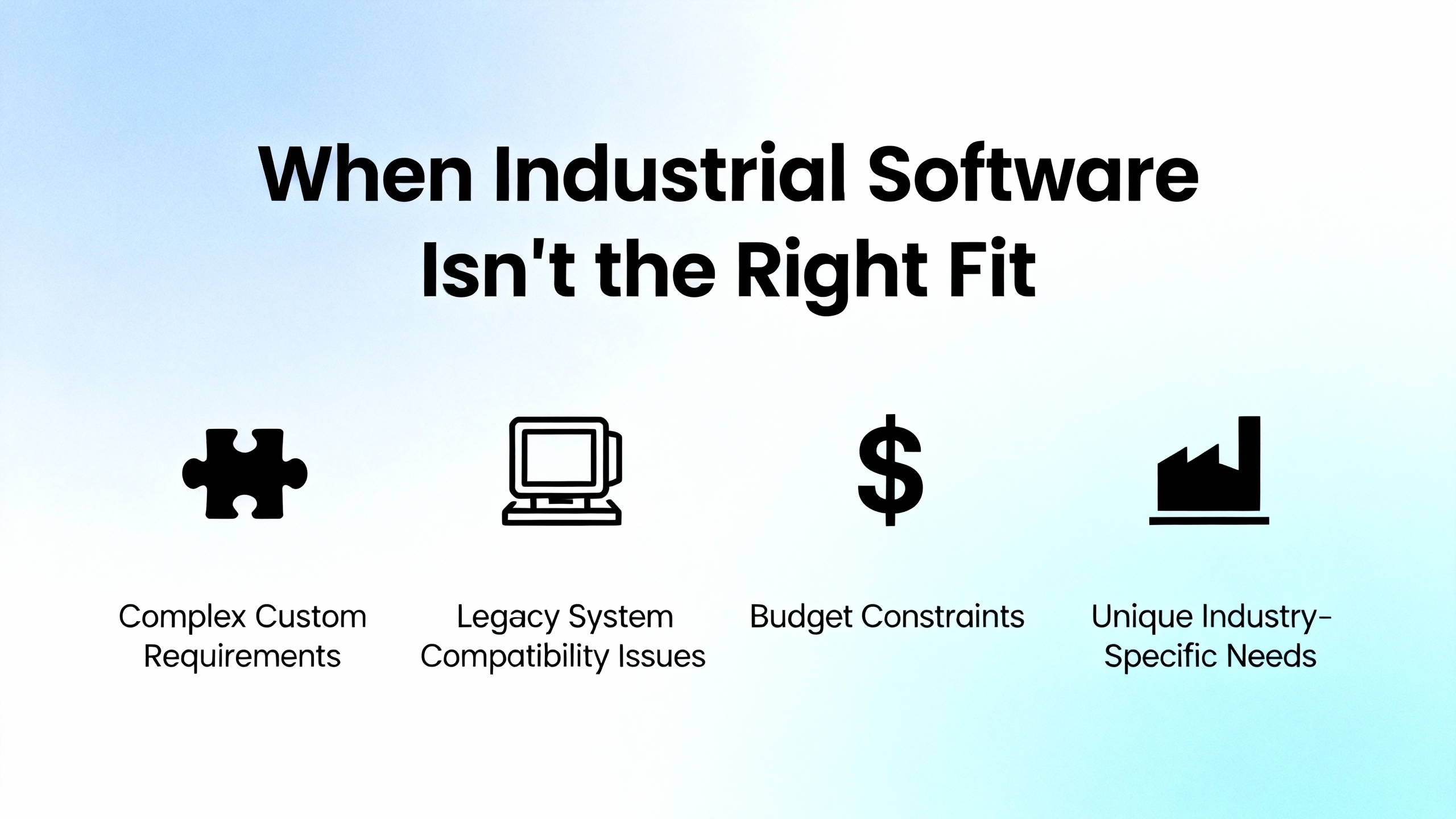
On site, the decision to move away from ABB drives tends to crystallize around a few recurring questions rather than abstract brand preferences. The research summarized in this brief aligns well with those questions.
The first question is about criticality versus budget. OMCH opens its guide by calling downtime the biggest enemy in industrial manufacturing and stressing that selecting the right supplier is essential when you are building a new high-tech line or hunting for a critical spare at three in the morning. If the application is safety-critical or production-critical, and the cost of failure is very high, staying with ABB and using official upgrades, or choosing a Tier 1 alternative like Yaskawa, Siemens, Rockwell, or Mitsubishi, often makes more sense than chasing the lowest price. Cost-effective suppliers such as Delta or Autonics can be excellent for non-core functions or well-understood machine designs, but they still require disciplined engineering and testing.
The second question is ecosystem alignment. Several sources describe how Siemens and Rockwell dominate in specific regions and sectors, and how ABB is particularly strong in heavy industries and power integration. If your plant standardizes on Rockwell PLCs and FactoryTalk, or on Siemens SIMATIC and TIA Portal, then using their drive families simplifies training, spare parts, and integration. By contrast, if your site is heavily invested in ABB’s System 800xA DCS and ACS drives, it might be more efficient to stay with ABB and exploit its modernization offerings rather than fragmenting the control stack.
The third question is lifecycle and support. Yaskawa’s long-term quality leadership positioning, along with its emphasis on never cutting corners, illustrates how quality culture at the OEM level can translate into lower lifecycle costs for users. On the other hand, surplus suppliers like Industrial Automation Co remind us that buying outside authorized channels can void OEM support and leave firmware and licensing questions unanswered. Repair houses such as Roc Industrial and UpFix mitigate some of that risk by backing their work with multiyear warranties and defined diagnostic processes, but they remain independent of the OEMs. Evaluating ABB alternatives therefore means not only comparing nameplates but also comparing warranty terms, spare-part access, and the availability of field engineers.
The fourth question is supply-chain resilience. OMCH draws a sharp line between OEMs with longer production lead times, distributors with deep stock and fast shipping, cost-effective Asian suppliers reshaping the rules with aggressive pricing, and surplus specialists who keep end-of-life equipment running. In practice, most robust strategies combine multiple channels. You might standardize on a primary OEM like ABB, Yaskawa, or Siemens, rely on authorized distributors for most MRO needs, keep relationships with surplus specialists or Classic Automation for legacy gear, and build repair capacity with partners like Roc Industrial or UpFix for critical drives where downtime is unacceptable.
The fifth question is digital readiness. Verified Market Research and other sources emphasize how factory automation is increasingly defined by integration of AI, IoT, and cloud-based platforms. ABB, Siemens, Rockwell, Mitsubishi, and others are all evolving their offerings to combine drives, PLCs, robots, and software into cohesive digital ecosystems. If you plan to deploy advanced analytics, predictive maintenance, or AI-based quality control, you need to think about which vendor or combination of vendors will give you the right balance of openness and integration.
In real projects, these factors rarely point to a single “best” ABB alternative. Instead, they guide a series of trade-offs that depend on your installed base, your risk appetite, and your long-term automation roadmap.
Q: When does it make more sense to stay with ABB rather than switch to an alternative drive supplier?
A: It usually makes more sense to stay with ABB when you already have significant ABB infrastructure, your critical applications depend on features available in ABB’s drive and control ecosystem, and ABB’s upgrade paths or repair options can extend lifecycle at acceptable cost. ABB’s own modernization packages for ACS1000, ACS5000, ACS6000, PCS6000, and MEGADRIVE-LCI drives are specifically designed to preserve existing hardware investments while bringing controls and cybersecurity up to current standards. In these cases, the engineering and commissioning effort of a platform change can outweigh the savings from moving to another brand.
Q: Are surplus and refurbished ABB drives safe to use as alternatives to new ABB hardware?
A: Surplus and refurbished drives from third-party suppliers can be safe and cost-effective in the right context, but they come with risks that you need to manage. Industrial Automation Co, for example, clearly states that it is not an authorized distributor, that it does not claim specific quality-control measures, and that OEMs may decline to provide technical support or warranty service for the items it sells. Product attributes and software licensing are also not guaranteed. If you use such sources, you should reserve them for non-critical applications or be prepared to rely on your own or third-party engineering resources to validate, install, and maintain the equipment. Working with repair providers that test under load and offer clear warranties, such as Classic Automation, Roc Industrial, or UpFix in their respective niches, can reduce but not eliminate these risks.
Q: Is there a single “best” ABB competitor for drives?
A: The research shows that there is no universal best ABB competitor. Yaskawa stands out for a quality-first approach in AC drives, Delta for price-to-performance in mid-range OEM machines, Mitsubishi Electric for precision equipment and Asian markets, and Siemens and Rockwell for deeply integrated control architectures in their respective strongholds. The “best” choice depends on your application, geography, installed base, budget, and digital strategy. A disciplined evaluation that considers OEM capabilities, channel options, repair strategies, and software integration will deliver far better results than chasing one brand name.
In the end, the right ABB drive alternative supplier is the one that keeps your process running, your operators safe, and your management confident in the numbers. Approached with clear priorities and a realistic view of the trade-offs, the current market offers more than enough options to build a drive strategy that works for your plant rather than the other way around.


Copyright Notice © 2026 mooreautomated.com All rights reserved,Moore Automated is not an authorized distributor or representative of the manufacturers featured on this website. Brand names and trademarks featured are the property of their respective owners.
Leave Your Comment