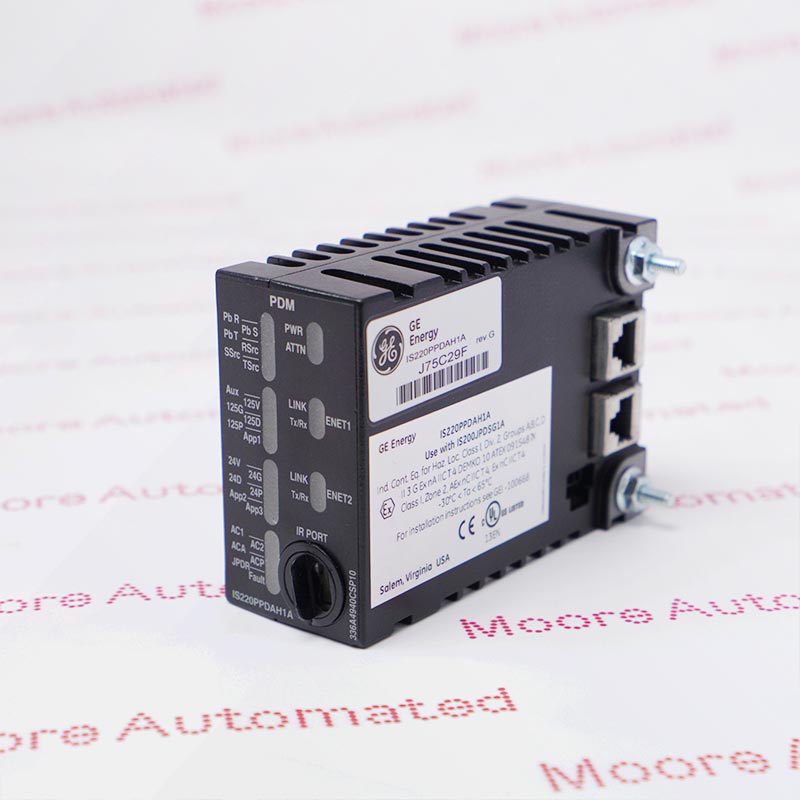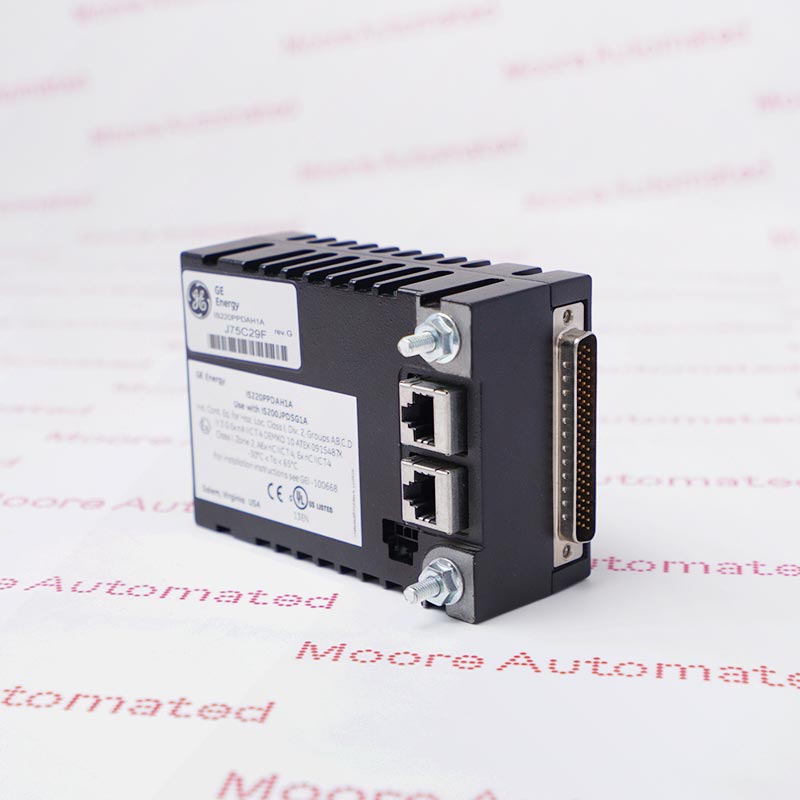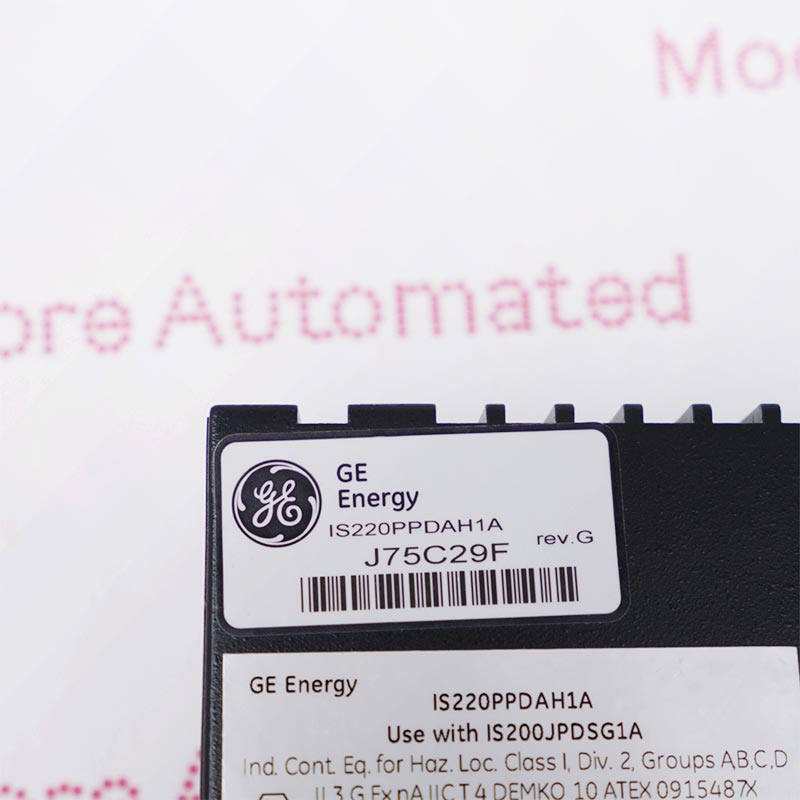





a Power Distribution System Feedback Board manufactured
and designed by General Electric as part of the Mark Vle Series
used in distributed controsystems
The Power Distribution System Feedback(PPDA) I/O pack
can receive inputs from as many as six power distribution boards
or as many as six sets of feedback signals
What is the fundamental functional architecture and signal acquisition methodology employed by the IS220PPDAH1A within a GE Mark VIe distributed control framework?
The IS220PPDAH1A operates as an input/output (I/O) pack within the GE Mark VIe control system, designed for high-integrity signal acquisition and processing. It interfaces with the controller via high-speed communication links, enabling deterministic data exchange for critical process and turbine control applications.
How does the IS220PPDAH1A ensure deterministic data integrity and fault tolerance in safety-critical industrial environments?
The IS220PPDAH1A incorporates redundant communication pathways and diagnostic monitoring capabilities to maintain data integrity. It continuously performs self-diagnostics and supports system redundancy architectures to enhance fault tolerance and minimize single points of failure.
What types of analog and digital signal conditioning and interfacing capabilities are integrated into the IS220PPDAH1A module?
The IS220PPDAH1A supports conditioned signal interfacing for both analog and discrete signals. It performs signal scaling, isolation, and filtering before transmitting data to the Mark VIe controller, ensuring high-precision measurement and noise immunity.
In what manner does the IS220PPDAH1A implement galvanic isolation and electromagnetic compatibility (EMC) protection?
The IS220PPDAH1A is engineered with robust galvanic isolation barriers and EMC shielding to protect against voltage transients, ground loops, and electromagnetic interference, thereby ensuring stable operation in harsh industrial environments.
What diagnostic and health monitoring features are embedded within the IS220PPDAH1A to facilitate predictive maintenance strategies?
The IS220PPDAH1A continuously executes onboard diagnostics, including communication status checks, internal fault detection, and signal integrity verification. These diagnostics support condition-based maintenance and early fault detection.
How does the IS220PPDAH1A integrate into the broader GE Mark VIe system topology and what role does it play in distributed control?
The IS220PPDAH1A functions as a localized I/O processing node within the distributed architecture of the Mark VIe system, interfacing field devices with the central controller while reducing latency and improving system modularity.
What environmental and operational specifications govern the reliability and deployment constraints of the IS220PPDAH1A?
The IS220PPDAH1A is designed to operate within industrial temperature, humidity, and vibration limits specified in the datasheet. It is suitable for deployment in power generation, oil & gas, and heavy industrial environments where environmental robustness is essential.
For more information on how your data is processed and stored by Moore automated please read our privacy policy.
Trusted by 5,000+ plants worldwide | Backed by our vast inventory of top-tier control parts, drives and servo motors, fast shipments are dispatched to cover your urgent needs. ABOUT US >>
Moore Disclaimer: Moore Automated's sales automation equipment and related solutions are intended for industrial automation and business operational efficiency improvement purposes only. Product information, technical parameters, and application cases are for reference only and do not constitute an absolute guarantee of performance for any specific industry, scenario, or final application. Actual equipment performance may vary depending on factors such as the usage environment, system integration method, and maintenance conditions. Users should confirm compatibility and safety based on professional technical assessments. Moore Automated assumes no liability for any direct or indirect losses caused by improper use, modification, or failure to operate according to specifications, to the extent permitted by law.