



Understand Triconex TMR architecture, safety-system boundaries, online maintenance considerations and the evidence needed for a precise spare-parts enquiry.
Three processing paths.
One governed safety function.
Fault-tolerant architecture supports availability, but the installed application still depends on approved logic, field devices, diagnostics and lifecycle procedures.
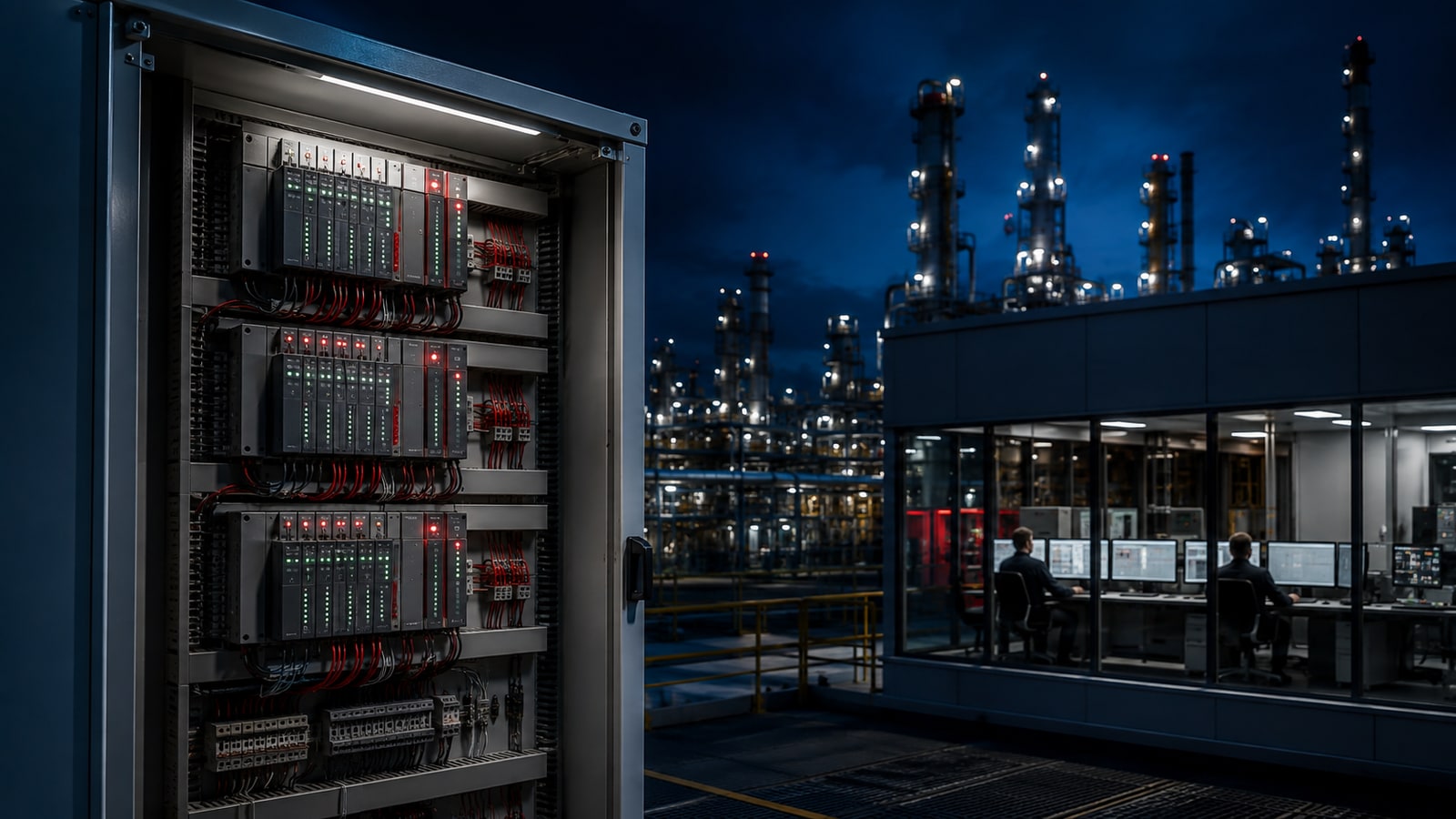
A Triconex Tricon system uses triple modular redundant architecture to execute critical control logic across three parallel paths. The architecture is designed to detect and tolerate defined faults; it does not remove the need to verify the exact controller, I/O, termination, software release and certified application constraints.
How TMR moves a signal through the system
Three isolated paths
Input channels are conditioned and processed independently according to the installed module design.
Parallel logic execution
Main processors execute the application and compare results through the Tricon architecture.
Controlled field response
Output architecture and diagnostics support the documented safety function and termination design.
TMR is an architectural property. SIL capability applies only within the manufacturer’s certified hardware, software and application conditions. A replacement module is not an approval to modify or return a safety function to service.
What to verify before planning online maintenance
Hardware identity
Record the full part number, revision, chassis position, termination assembly and connected field circuits. Mechanical fit alone does not establish compatibility.
System context
Keep the Tricon or Tricon CX generation, TriStation release, project records, diagnostics and approved maintenance procedure connected to the enquiry.
Fault state
Document active alarms and channel status before any work. Online replacement is a platform capability used only under the applicable manual and site procedure.
Acceptance evidence
Define condition, inspection scope, photographs, documentation, warranty and delivery terms before accepting a commercial offer.
Build a traceable Triconex spare-parts request
Start with the exact installed reference. For example, a request for a main processor should identify the processor model and system version; a digital I/O request should also include voltage, point configuration and external termination context. Browse Moore Automated’s industrial parts coverage and use a specific Triconex 3008 product record only as sourcing references.
- Photograph the front label, side label and connectors clearly.
- State quantity, required condition and whether the unit is for an emergency spare or planned outage.
- List chassis, slot, termination and system release information available.
- Request the offered item’s exact identifiers, inspection evidence, warranty and dispatch terms in writing.
For wider planning, review the TMR processor evidence guide and Moore Automated’s storage-facility overview.
Questions maintenance teams ask
01Does TMR mean a single module failure can be ignored?
No. Fault tolerance is designed to manage defined faults while diagnostics and maintenance procedures direct the response. Investigate alarms promptly under the approved safety lifecycle.
02Can every Triconex module be replaced online?
Do not generalize. Confirm the exact module, chassis, system state, applicable manual and approved site procedure before any online work.
03Does a SIL statement approve my application?
No. Certification has defined hardware, software, configuration and application conditions. The responsible functional-safety team determines suitability.
04What belongs in a Triconex sourcing enquiry?
Send full part numbers, revisions, system generation, slot and termination context, quantity, condition, evidence requirements, destination and deadline.
05Is Moore Automated an authorised Triconex distributor?
Moore Automated is an independent industrial automation parts supplier, not an authorised manufacturer distributor or representative.
Need a clearly identified Triconex spare?
Send the complete module reference and installed-system context. The commercial sourcing review remains separate from the site’s functional-safety decision.
Original article videoWatch
The video from the original published article is retained as supplementary company content. It is not a compatibility approval, product test record or lifecycle notice.


Leave Your Comment