Overview
Manuals
Principle
Features:
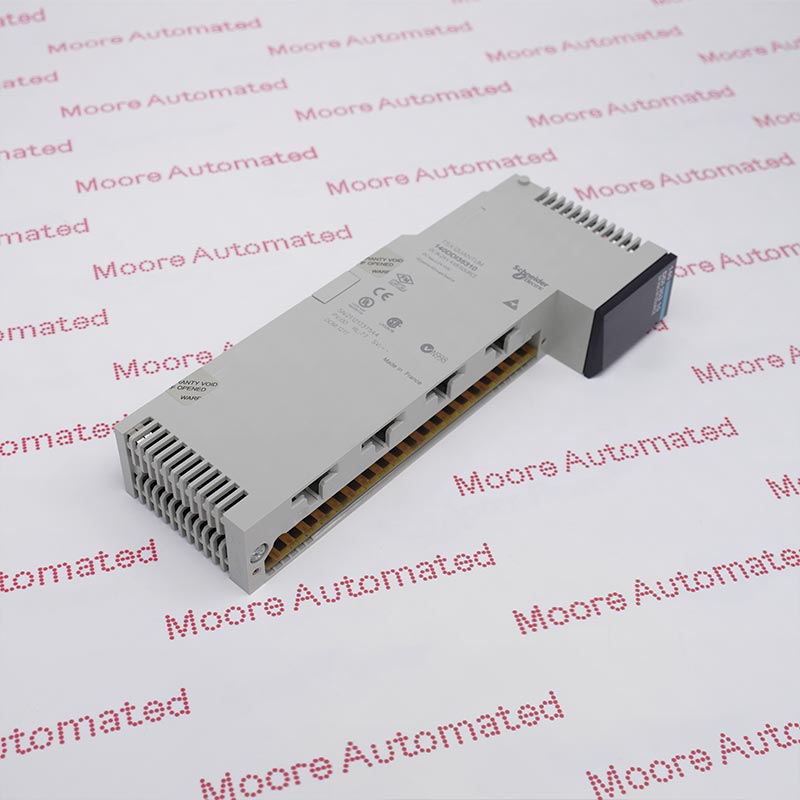
- Analog output module M340 - 8 outputs
- This analogue output module has 8 outputs with 16bit resolution
- Analog non isolated high level output module, Modicon X80, 0 to 20mA, 4 to 20mA
This module primarily converts digital control signals from the PLC into standardized analog electrical signals and outputs them to field actuators. It supports common industrial voltage and current output ranges (e.g., 0–10 V, 4–20 mA) and can directly drive analog control devices such as control valves, frequency converters, and proportional controllers. As a key interface between the control system and the field actuator layer, the BMXAMO0802 enables high-precision, continuous process control output.
At the system integration level, the BMXAMO0802 communicates with the CPU in real time via the M340 backplane bus, receiving output data words from the control program and performing independent channel-level conversions. This module features channel isolation, diagnostic functions, and status indication capabilities, detecting open circuits, short circuits, and other anomalies, thereby improving system reliability and maintainability. Its high-resolution output capability is suitable for closed-loop control scenarios such as temperature, pressure, and flow, providing stable signal support for complex industrial process control.
The BMXAMO0802 Schneider Electric Analog output module may still be available for purchase and support from Moore Automated Company beyond End-Of-Life (EOL) by the manufacturer (OEM).
Schneider Electric BMXAMO0802 Analog output module Manuals(Datasheets), Link
Important Notice: Other accessories, manuals, cables, calibration data, software, etc. are not included with this equipment unless listed in the above stock item description. All prices are shown in USD.
In terms of operating principle, the Schneider Electric BMXAMO0802 uses a high-precision digital-to-analog converter (DAC) to convert the PLC's internal digital data into corresponding voltage or current signals. After the CPU writes the target output value into the module register, the internal circuitry of the module performs linear scaling and conversion according to the set range ratio, and then outputs a standard analog signal through the signal conditioning circuit. This module includes a reference voltage source, amplifier, and protection circuitry to ensure the stability and anti-interference capability of the output signal, thereby achieving precise, continuous, and repeatable industrial analog control output.