Overview
Manuals
Industry Applications
Certification and Standards
Features:
- Designed as an analog input module within the SLC 500 series
- This unit supports both Class 1 and Class 3 configurations, making it versatile for a range of control systems
- High-impedance differential or single-ended inputs
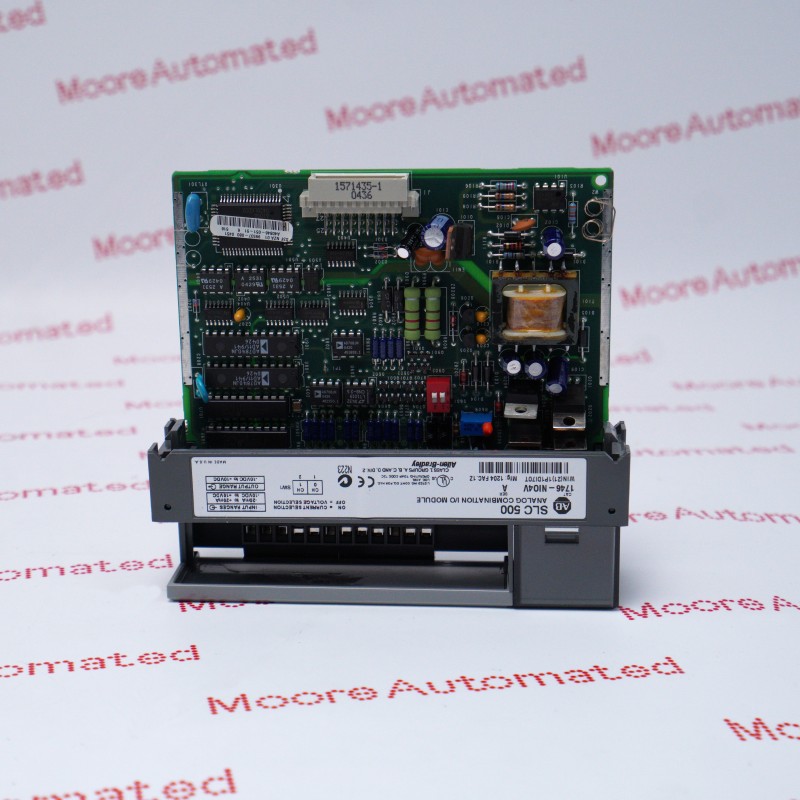
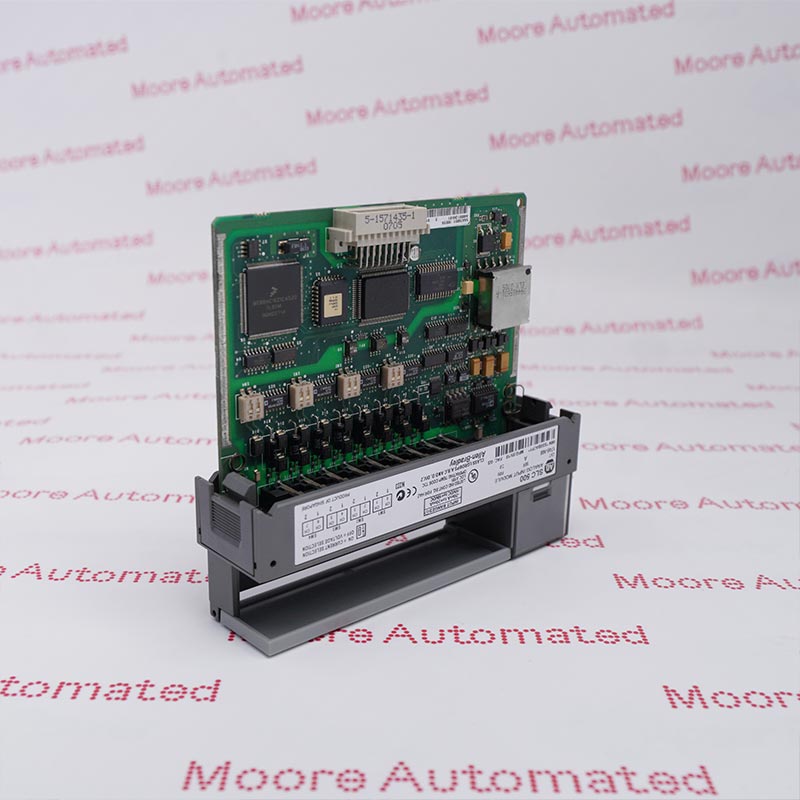
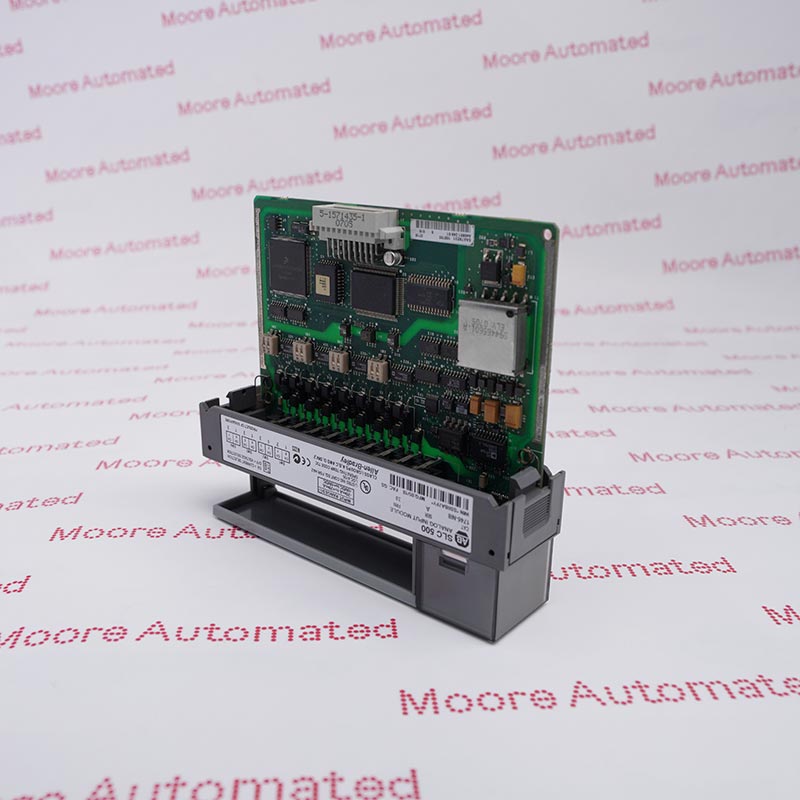
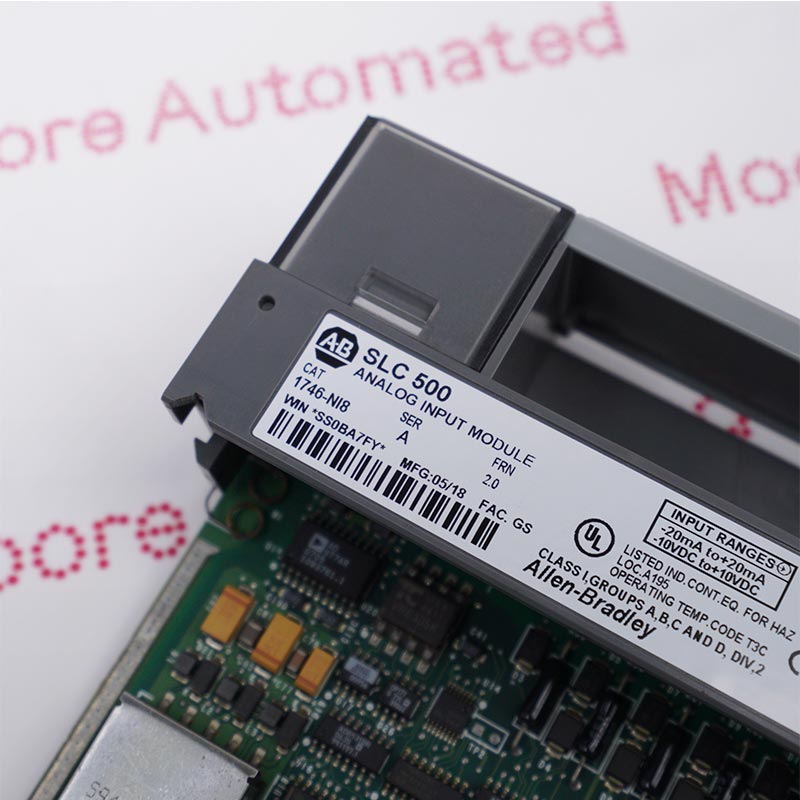
The Allen Bradley 1746-NI8 is an analog input module belonging to the SLC 500 series. This module can handle up to eight high-resolution input signals and supports both differential and single-ended configurations, providing flexible connectivity. Its input voltage range is -10 to 10V DC, with additional ranges of 1 to 5V DC and 0 to 10V DC, allowing connection to a wide variety of sensors and devices. The input current range is also highly flexible, with options including 0 to 20 mA and 4 to 20 mA. The module supports different levels: Level 1 supports 8 output words and 8 input words, while Level 3 expands to 12 output words and 16 input words to meet more demanding application requirements.
The 1746-NI8 also integrates indicator lights to display input status, enhancing the ease of troubleshooting and maintenance. The 1746-NI8 features a compact design, occupying only one slot, allowing for seamless integration into existing systems and making it ideal for a variety of automation configurations. Its versatility and powerful performance make it a key component for achieving precise control and monitoring in industrial environments.
The 1746-NI8 Allen Bradley Analog Input Module may still be available for purchase and support from Moore Automated Company beyond End-Of-Life (EOL) by the manufacturer (OEM).
Allen Bradley 1746-NI8 Analog Input Module Manuals(Datasheets), Link
Important Notice: Other accessories, manuals, cables, calibration data, software, etc. are not included with this equipment unless listed in the above stock item description. All prices are shown in USD.
1. Process Variable Monitoring in Fluid Dynamics:
Flow Optimization: This module monitors continuous analog signals from electromagnetic flowmeters, vortex flowmeters, and ultrasonic flowmeters (typically 4–20 mA loops) to measure fluid velocities in pipelines within chemical batch production units and water supply networks.
Hydrostatic Level and Tank Monitoring: This module maps input signals from differential pressure sensors, radar level transmitters, and ultrasonic level transmitters to calculate real-time volumetric storage data within industrial chemical storage tanks or silos.
Pipeline Pressure Regulation: This module connects directly to high-precision piezoresistive pressure sensors to monitor hydraulic lines, gas pipelines, or steam manifolds and flag instantaneous pressure spikes or drops to prevent catastrophic pipeline failures.
2. Thermal Management and Environmental Control:
Accurate Temperature Tracking: This module receives precise voltage signals from remote temperature transmitters (connected to thermocouples or resistance temperature detectors (RTDs)), which is crucial for protecting industrial baking ovens, metal annealing furnaces, and refrigeration equipment.
HVAC Chillers and Air Quality Control: This module reads variables from a carbon dioxide (CO₂) analyzer, humidity sensor, and airflow transmitter to dynamically adjust the operation of large industrial air handling units (AHUs) and the position of dampers in cleanrooms.
3. Machine Automation and Analytical Measurement
Mechanical Positioning and Clamping: This module processes analog signals from linear variable differential transformers (LVDTs) or series potentiometers (0-10V) to verify structural alignment, die positioning on presses, or the extension of hydraulic cylinders.
Analytical Water and Gas Quality System: It is integrated into a dedicated process loop to track pH transmitters, dissolved oxygen (DO) probes, and conductivity sensors within municipal wastewater treatment plants and toxic gas scrubbing chimneys.
1. North American Safety and Hazardous Location Classification:
UL Certification: Officially certified by Underwriters Laboratories (UL) in the United States, conforming to UL 508 standards, indicating it is an approved industrial control device.
CSA Certification: Certified by the Canadian Standards Association (CSA), conforming to CSA C22.2 No. 142 standards, meeting safety compliance standards for process control equipment.
Class I, Zone 2 (Groups A, B, C, D): Certified by both UL (C-UL) and CSA, safe for operation in hazardous plant areas where explosive or flammable gases/vapors may occasionally accumulate.
2. International Electrical and Compatibility Directives:
CE Mark: Bears the EU CE mark, indicating full compliance with the Low Voltage Directive (LVD) and Electromagnetic Compatibility Directive (EMC), and conforming to EN 61131-2 standards. It ensures the module is protected against radio frequency interference (RFI) during 16-bit analog data conversion.
C-Tick (RCM) Certification: Fully compliant with the Australian and New Zealand Radiocommunication Framework Guidelines, ensuring its internal switching architecture can suppress excessive line noise.
3. Structural and Voltage Isolation Thresholds:
The backplane is optically isolated and proven to withstand voltages up to 750V DC / 500V AC between the SLC 500 chassis backplane analog terminal input channels and sensitive digital logic, thus preventing surge damage to the central PLC processor.