



Sustainable manufacturing is not a choice between keeping every old machine and replacing it all. It is a sequence of documented decisions: maintain what remains fit for purpose, measure where energy is used, and give retired components a responsible next destination.
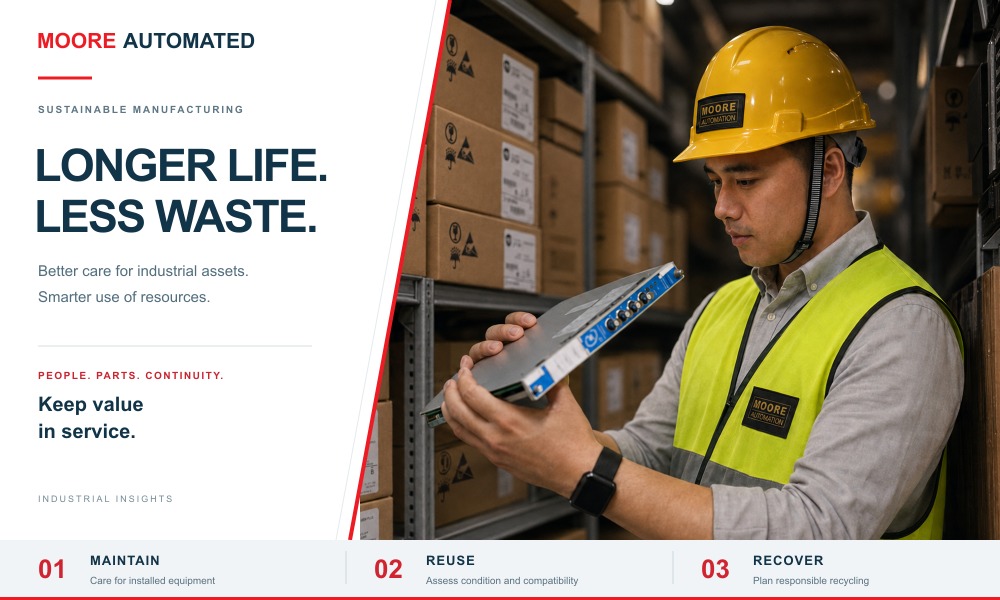
The newest device, the lowest purchase price and the longest possible service life are not automatically the same choice. Define the operating need and acceptance evidence before selecting a route.
Choose the next useful life—not just the next part
A production line may depend on a drive, controller or monitoring component that is aging or difficult to source. Evaluate the part in the context of its installed system: what function must it preserve, what evidence is needed, and how long must the solution remain supportable?
Maintain
Use operating records, manufacturer guidance and known failure modes to identify the maintenance task. A spare should relate to an installed asset and a defined plan—not sit indefinitely without an approved use.
Repair or reuse
Confirm compatibility, condition and the agreed inspection or functional acceptance criteria. Appearance alone cannot prove remaining life or suitability for a safety-related application.
Upgrade
When supportability, reliability or operating performance no longer meets the need, compare migration options. Include engineering, commissioning, configuration and production disruption—not hardware price alone.
Recover responsibly
Separate retired equipment from usable stock, select a suitable recovery route and keep the disposition evidence. Do not treat every removed component as reusable or every recycling claim as verified.
Efficiency needs a comparable baseline
Energy audits can identify opportunities in maintenance, equipment replacement and consumption outside production hours. For a plant-level comparison, record operating hours, load, output and measured energy; then compare equivalent operating conditions after the intervention.
A repaired module may restore a machine without changing its energy use. Keep reliability and efficiency objectives separate, and verify each against its own acceptance criteria.
The illustration is a hypothetical arithmetic example, not a customer result or a Moore Automated energy-saving claim.
Match the exact component to its installed duty
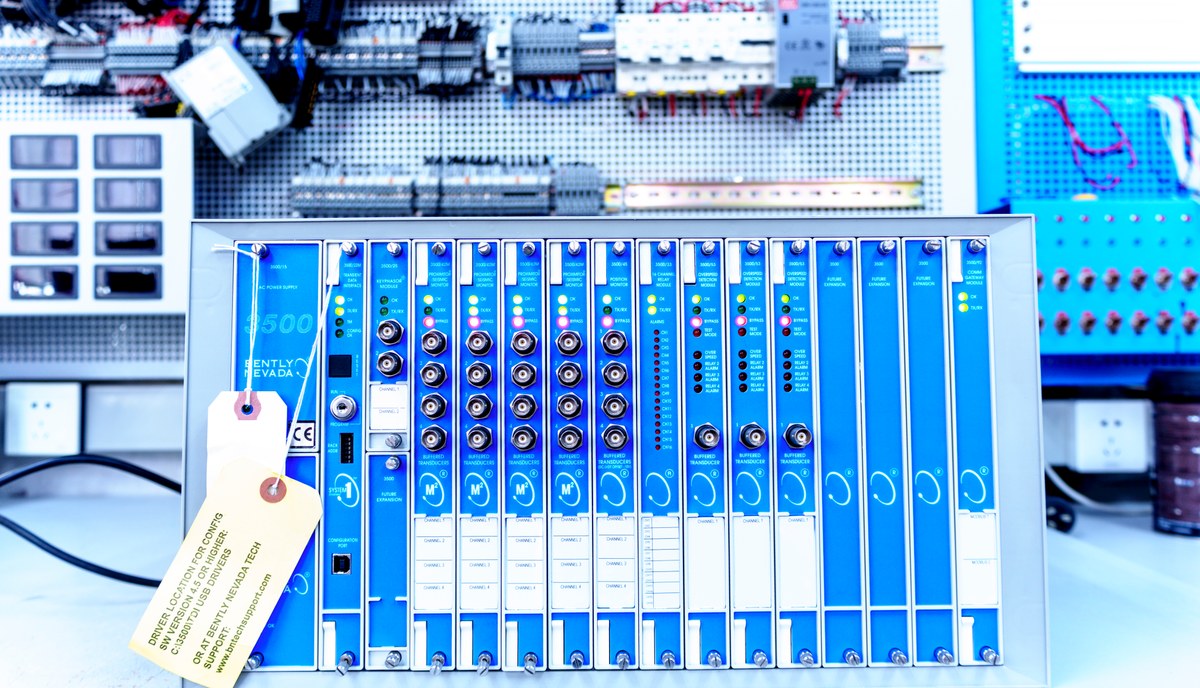
Industrial monitoring and control equipment can remain in service across long plant lifecycles. Before buying a replacement or reusable item, record the full manufacturer part number, suffix, revision or firmware, installed system, quantity and condition required.
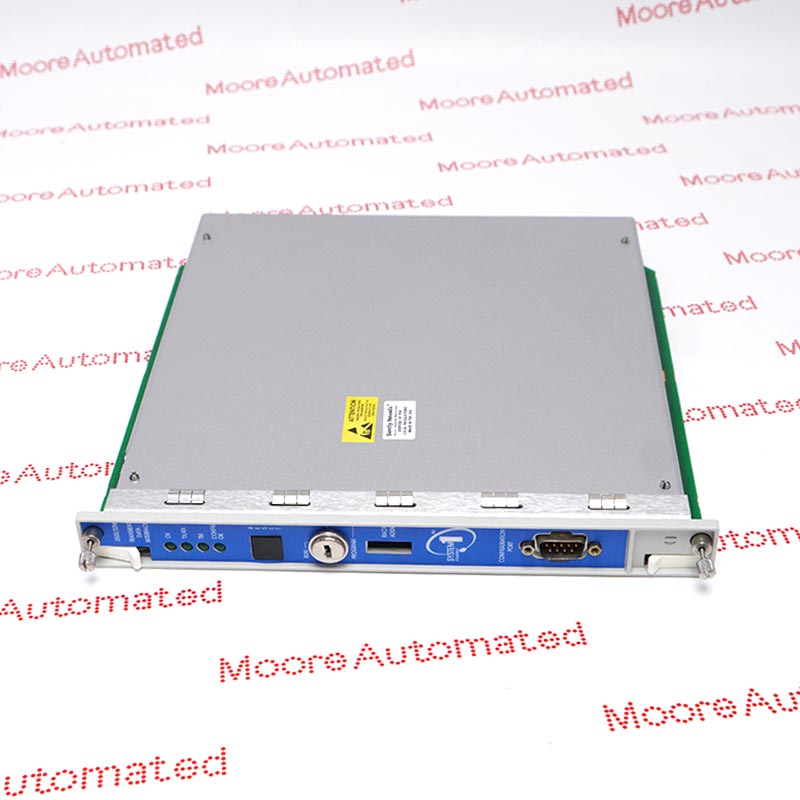
For a Bently Nevada 3500 system, the 3500/22M transient data interface must be assessed against the actual rack configuration and application. An ABB ACS550 drive likewise needs a like-for-like requirement or an engineered migration scope—not an assumed energy benefit.
Document any inspection and test scope in advance. A photograph can help identify packaging and visible markings, but it is not proof of internal condition, compatibility, certification or functional performance.
| Check | Record before sourcing | Why it matters |
|---|---|---|
| Identity | Complete manufacturer number, suffix and revision | Small code differences can change fit or function. |
| System fit | Installed platform, interfaces, firmware and configuration | Family resemblance does not guarantee interchangeability. |
| Condition | Required condition and agreed inspection or test evidence | Condition claims need a defined acceptance scope. |
| Lifecycle plan | Asset criticality, intended use and next review date | Stock should support a real maintenance decision. |
Moore Automated’s video channel includes industrial instrumentation context. The embedded overview below is not a model-specific acceptance test, recycling certification or measured sustainability result.
Make reuse and e-waste traceable
Reuse is most useful when it is legitimate, technically approved and documented. Keep serviceable items identifiable and linked to a future requirement. When a component has no suitable reuse route, use an appropriate recovery provider and retain the chain-of-custody or processing documentation.
The Global E-waste Monitor 2024 reports 62 million tonnes of e-waste generated worldwide in 2022 and 22.3% documented as formally collected and recycled in an environmentally sound manner. Those figures cover electrical and electronic equipment globally; they are not industrial-automation-only statistics.
What was removed · why it was retired · who received it · what recovery or disposition evidence was returned.
Connect lifecycle guidance to real sourcing needs
These product pages and cases provide related context. They do not claim that a specific repair, reuse route or energy saving occurred.
Availability, condition, lead time and warranty require current written confirmation. These cases are procurement and verification examples, not quantified environmental projects.
Frequently asked questions
Is keeping older equipment always more sustainable?
No. Compare condition, operating energy, failure consequences, supportability and expected remaining life with a feasible upgrade. A reliable repair may defer unnecessary replacement; an inefficient or unsupported system may warrant planned migration.
Can replacing an automation module guarantee energy savings?
No. Restoring operation does not prove reduced energy use. Establish a baseline and compare measured energy under equivalent production conditions after the intervention.
What should be checked before reusing a component?
Confirm the full part number, revision, firmware, available service history, storage condition and system compatibility. Agree documented inspection and acceptance criteria; safety-related applications need approval from the responsible engineering owner.
How should obsolete spare parts be managed?
Link each spare to an installed asset, criticality and maintenance plan. Periodically review preservation and support options; assess items without approved future use for legitimate reuse or responsible recovery.
Does Moore Automated certify recycling or environmental savings?
This article makes no such claim. Any repair, testing, take-back or recovery service and any environmental calculation must be agreed and evidenced separately with the responsible provider.
What information makes a lifecycle-focused enquiry useful?
Share the installed equipment, complete part number, revision or firmware, quantity, required condition, maintenance objective, inspection requirements, destination and required-on-site date. A clear nameplate photo and known compatibility constraints also help.
Planning to maintain, repair or upgrade?
Send the requirement with the maintenance objective so the sourcing discussion can distinguish a replacement need from a migration or verification question.
- Installed asset and complete part number / revision
- Quantity, required condition and acceptance evidence
- Destination, due date and compatibility constraints
Sources and review details
Sources checked October 8, 2026. Source titles are listed as plain text; no external source links are included.
Author: Miya Zheng, Sales Director at Moore Automated. Her existing author profile is used in the website’s fixed author area.
Technical reviewer: Miya Zheng · Reviewed: October 8, 2026.
Publication date: October 8, 2026.
Moore Automated is an independent industrial automation parts supplier. Manufacturer names remain the property of their respective owners; mention does not imply authorised distributor status.





Leave Your Comment