Overview
Manuals
Working principle
Installation Restrictions
Features:
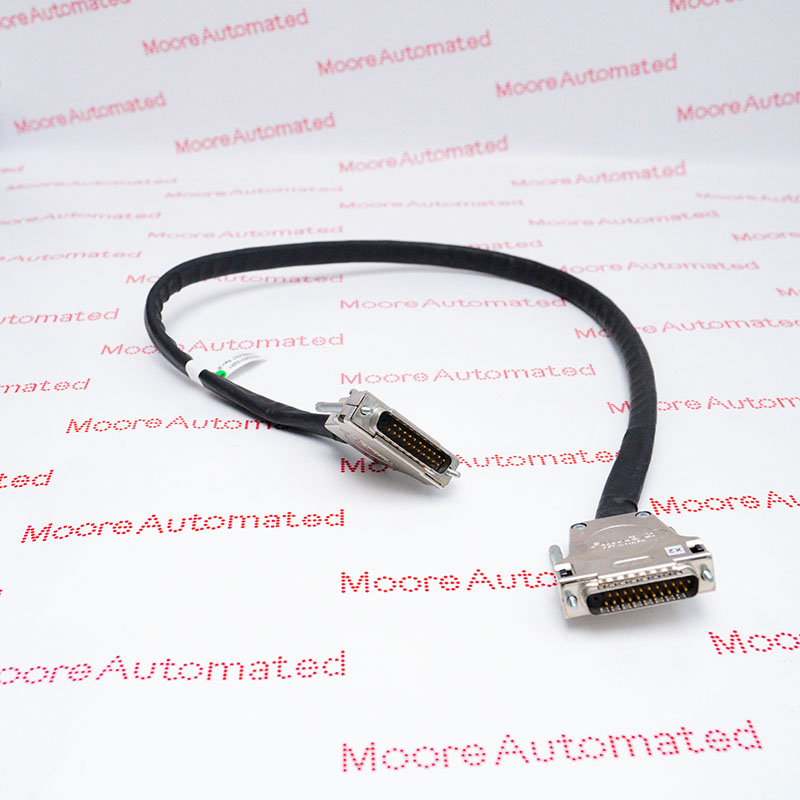
- CEX-Bus Extension Cable
- It is designed specifically for the System 800xA automation platform
- To interconnect and extend communication networks between rail-mounted AC 800M controller modules
By connecting the main controller and the backplane, it extends the communication boundaries of the controller in linear or redundant architectures, ensuring high-speed, low-latency data interoperability between various communication modules in industrial applications.
Functionally, the TK850V007 cable extends the basic signal between the CPU main control unit and various peripheral communication modules (such as fieldbus masters, industrial Ethernet interfaces, etc.).
The TK850V007 ABB CEX-Bus Extension Cable may still be available for purchase and support from Moore Automated Company beyond End-Of-Life (EOL) by the manufacturer (OEM).
ABB TK850V007 CEX-Bus Extension Cable maunal(Datasheets), Link
Important Notice: Other accessories, manuals, cables, calibration data, software, etc. are not included with this equipment unless listed in the above stock item description. All prices are shown in USD.
During system operation, high-frequency data frames between the CPU and communication peripherals are transmitted bidirectionally at high speed through this cable. Its fully shielded design effectively suppresses complex industrial electromagnetic interference in the field. In addition, by connecting a TK851 terminating resistor at the end of the link, reflected waves generated by high-frequency signals at the end of the line can be absorbed, thereby ensuring the absolute stability and accuracy of the bus waveform during long-distance or multi-module cascading processes.
According to ABB technical documentation, when using the TK850V007 extension cable, a TK851 CEX bus terminating resistor must be installed at the last physical node of the extended bus segment. Failure to install a suitable TK851 hardware terminating resistor will result in unstable communication loops, signal reflections, and consequently, random communication timeouts and module offline.