

Get Repair Quote
Name
Company *
Phone *
Email *
Address
City
State / Province / Region
Zipcode
Country
Quantity *
Part Number *
Manufacturer
Preferred Condition
Additional Information
Cancel
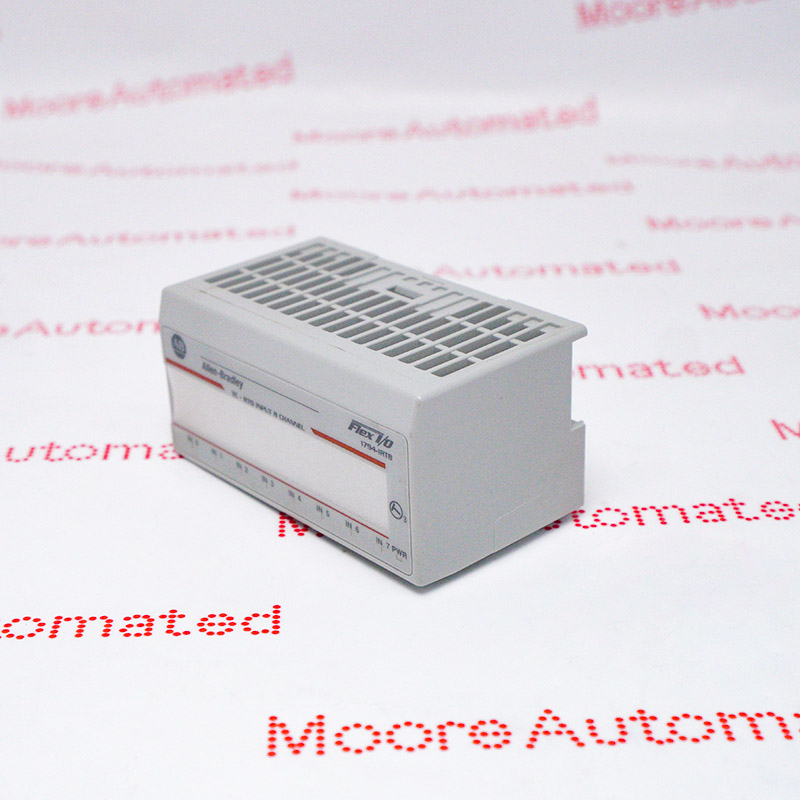
Allen-Bradley 1794-IRT8
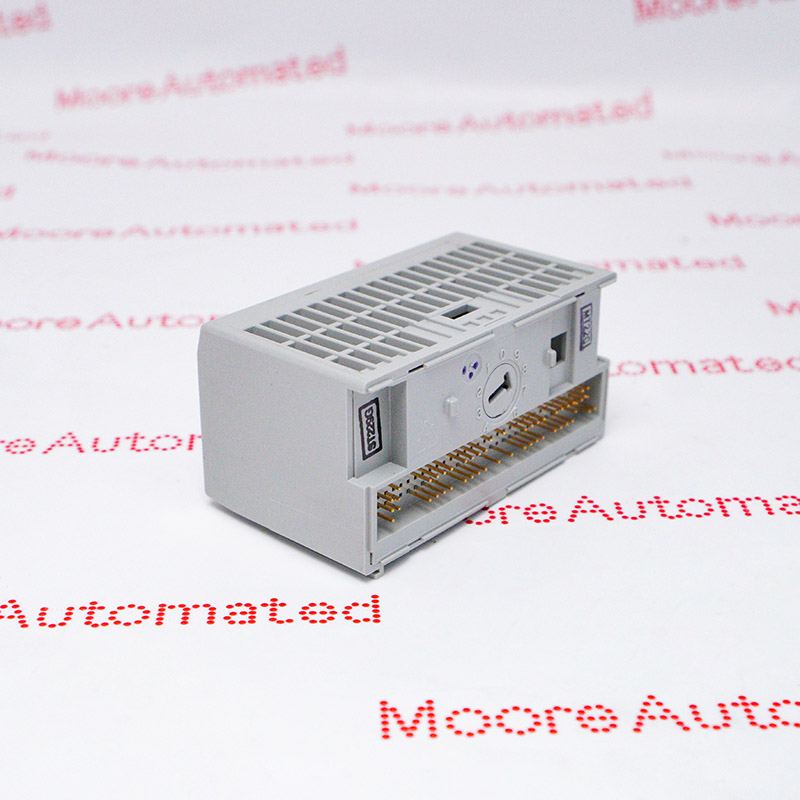
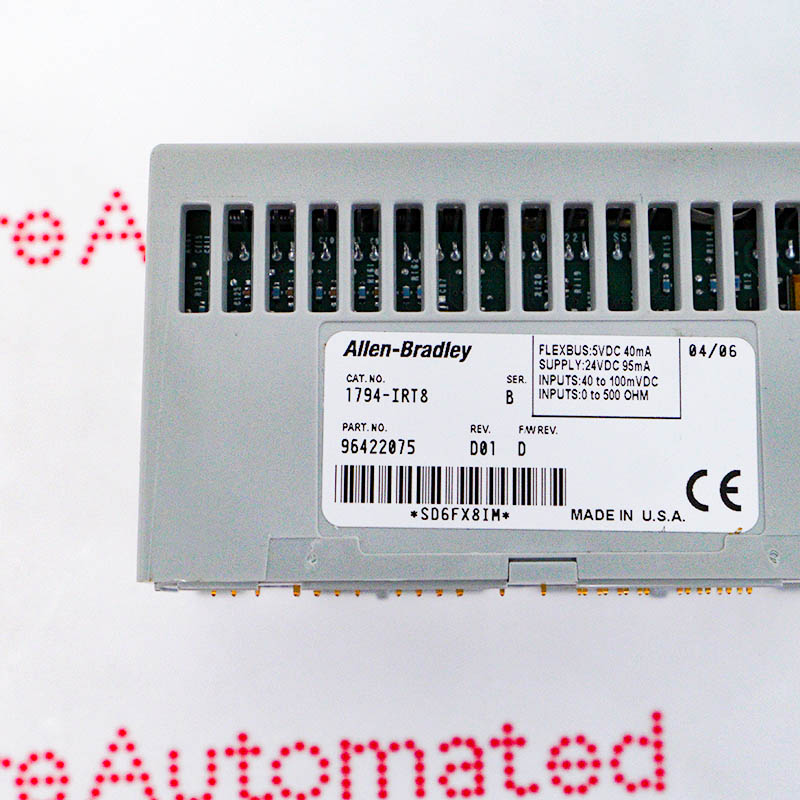
· Product image is representative; revision or series may vary. Contact us to request a specific version.

1794-IRT8

Flexible I/O module
In Stock

Product Information:

Flexible I/O module. This module supports both RTD and thermocouple sensors. It has 8 channels, divided into two groups of 4 channels each. The nominal input range for thermocouples is -40…100 mV DC, and the nominal input range for RTDs is 0…325 mV. The module has a 14-bit resolution.

Expand All
Collapse all

Technical specifications for 1794-IRT8

  • Manufacturer:
    Allen-Bradley
  • Product Category:
    PLC System
  • Spare Part Number:
    1794IRT8
  • Estimated shipping dimensions:
    13x13x8.7cm
  • Weight:
    0.2 kg
  • Tariff Code:
    8537101190
  • Country of origin:
    USA
  • Place of shipment:
    Xiamen, Fujian, China
  • Product Line:
    Flex I/O 1794
  • Number of channels:
    8-Channel
  • Nominal input voltage ranges:
    -40…100 mV DC for thermocouples 0…325 mV for RTDs mV default
  • Resolution:
    14 bits
  • Accuracy:
    0.05% of full range in mV mode with filtering selected Hardware only = 0.10% of full range in mV mode
  • Mounting:
    DIN Rail
  • Storage Temperature:
    –40…85 °C (–40…185 °F)
  • Operating Temperature:
    0 to 55 °C (32 to 131 °F)
  • Stock:
    100

Revisions

Revision Part #

Also known as

1794-IRT8/A
1794-IRT8 Ser A, Series A, Rev A
1794-IRT8/B
1794-IRT8 Ser B, Series B, Rev B

Information

Overview Manuals Main Features Key Industrial Applications

Features:

  • Flex I/O combination module
  • This module supports both RTD and Thermocouple sensors
  • This module has a resolution of 14 bits
The 1794-IRT8 module is an Allen-Bradley FLEX I/O millivolt, thermocouple, and RTD module. In a FLEX I/O system, the 1794-IRT8 module connects to the terminal block and power adapter. The Allen-Bradley 1794-IRT8 comes with two cold junction compensators. These compensators improve the module's accuracy in thermocouple mode.

The 1794-IRT8 module has a nominal voltage of 24 volts DC and provides eight analog inputs. It can connect to up to eight RTD or thermocouple inputs. The front panel of the 1794-IRT8 module includes a nameplate for module identification, a user-customizable removable label, a push-button switch position indicator, and LED status indicators.

The 1794-IRT8 Allen Bradley Flexible I/O module may still be available for purchase and support from Moore Automated Company beyond End-Of-Life (EOL) by the manufacturer (OEM).
Allen Bradley 1794-IRT8 Flexible I/O module manual(Datasheets), Link Important Notice: Other accessories, manuals, cables, calibration data, software, etc. are not included with this equipment unless listed in the above stock item description. All prices are shown in USD.
The 1794-IRT8 has diagnostic functions embedded including an open circuit detection wherein module reading upscales or defaults to max value when in RTD and Thermocouple mode. It also has an open input detection time of 2 scans, overvoltage capability of 15V DC continuous at 25 °C.
1. Oil, gas, and chemical processing
2. Power generation and utility skid-mounted equipment
3. Industrial ovens, kilns, and glass manufacturing
4. Food and beverage pasteurization and CIP systems

Ask our team:

  • How does the 1794-IRT8 acquire high-precision temperature signals from RTD sensors?
    The 1794-IRT8 performs precise resistance-to-digital conversion, interpreting changes in the resistance of the RTD element as proportional temperature values ​​through internal signal conditioning and linearization algorithms.
  • Why is the 1794-IRT8 considered an essential module for high-resolution thermal monitoring in industrial processes?
    The 1794-IRT8 supports multi-channel, high-precision temperature acquisition, making it suitable for applications requiring fine thermal stability control and process optimization.
  • In which industrial applications is the 1794-IRT8 most commonly used?
    The 1794-IRT8 is widely used in process industries, manufacturing systems, machine condition monitoring, HVAC systems, and thermal conditioning processes requiring distributed temperature sensing.
  • How does the 1794-IRT8 enhance signal integrity and measurement accuracy in noisy industrial environments?
    The 1794-IRT8 employs input filtering, isolation, and digital conversion technologies to minimize noise interference and ensure stable RTD measurement accuracy.
  • How does the 1794-IRT8 ensure long-term measurement stability and operational reliability?
    The 1794-IRT8 employs industrial-grade analog front-end circuitry and digital compensation technology to maintain consistent accuracy over extended operating cycles.
Quantity
Upload
(gif, jpg, jpeg, png, bmp, doc, docx, xls, xlsx, ppt, pdf, csv)
For more information on how your data is processed and stored by Moore automated please read our privacy policy.
Trusted by 5,000+ plants worldwide | Backed by our vast inventory of top-tier control parts, drives and servo motors, fast shipments are dispatched to cover your urgent needs. ABOUT US >>
Moore Disclaimer: Moore Automated's sales automation equipment and related solutions are intended for industrial automation and business operational efficiency improvement purposes only. Product information, technical parameters, and application cases are for reference only and do not constitute an absolute guarantee of performance for any specific industry, scenario, or final application. Actual equipment performance may vary depending on factors such as the usage environment, system integration method, and maintenance conditions. Users should confirm compatibility and safety based on professional technical assessments. Moore Automated assumes no liability for any direct or indirect losses caused by improper use, modification, or failure to operate according to specifications, to the extent permitted by law.