Overview
Manuals
Principle
Machine Applications
Features:
- TP100, TP500 General Purpose Accelerometer
- 1/4-28 to 1/4-28 and 1/4-28 to M8 mounting studs and box supplied
- Improved signal-to-noise ratio vs. other general purpose accelerometers
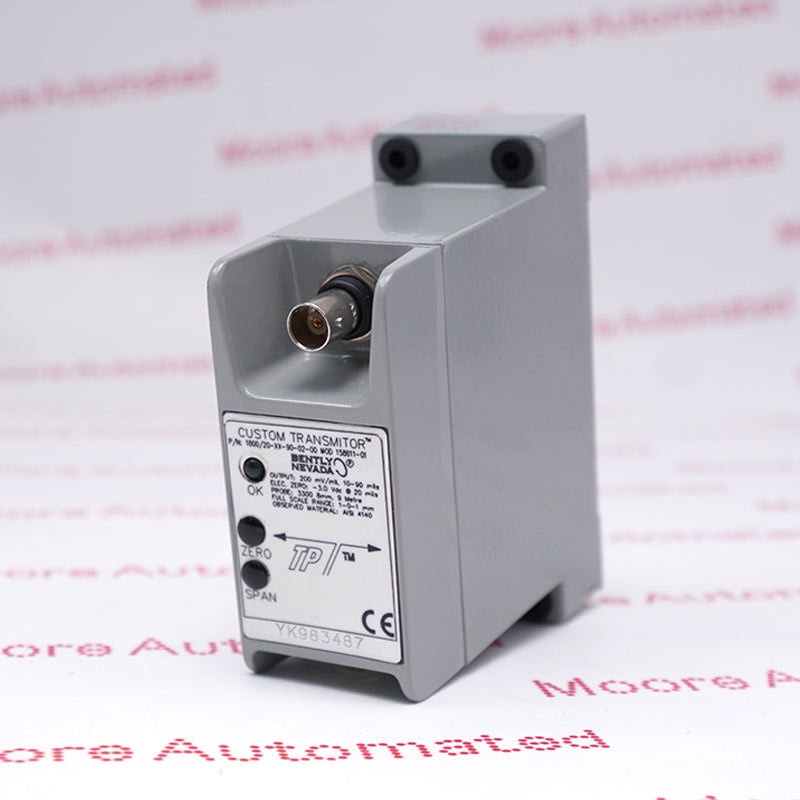
This series of accelerometers features a variety of characteristics that make them ideal for harsh industrial environments and space-constrained installations. These enclosed accelerometers provide acceleration measurements in g or m/s².
The sensor has a standardized output voltage proportional to the magnitude of the acceleration, enabling it to connect to a wide range of condition monitoring solutions. These sensors can detect vibration frequencies ranging from 0.2 to 14,000 Hz.
The TP100 Bently Nevada General Purpose Accelerometer may still be available for purchase and support from Moore Automated Company beyond End-Of-Life (EOL) by the manufacturer (OEM).
Bently Nevada TP100 General Purpose Accelerometer Manuals(Datasheets), Link
Important Notice: Other accessories, manuals, cables, calibration data, software, etc. are not included with this equipment unless listed in the above stock item description. All prices are shown in USD.
This sensor operates based on the principle of piezoelectric sensing. Inside the sensor, a piezoelectric crystal is coupled to a mass. When the accelerometer is subjected to vibration or dynamic motion, the inertia of the mass exerts a force on the piezoelectric element. This mechanical stress causes the crystal to generate a charge proportional to the applied acceleration. The generated charge is then converted into a voltage signal through internal signal conditioning circuitry. This output signal directly corresponds to the vibration amplitude and frequency of the monitored equipment, enabling the monitoring system to analyze machine condition, detect imbalances or misalignments, and support predictive maintenance strategies.
The TP100 is optimized for monitoring mechanical equipment with low-speed rotating parts or complex gears:
1. Cooling Tower Fans: Monitors low-frequency vibrations characteristic of large, low-speed fan assemblies.
2. Low-Speed Gearboxes: Detects early signs of gear meshing problems and bearing failures in industrial gear drives.
3. Level 2 and 3 Assets: Designed for low- to medium-risk equipment requiring frequent monitoring but potentially not requiring the highest-cost protection systems.
4. Rolling Bearings (REB): Capable of detecting high-frequency "stress waves" associated with early bearing wear.