


Registered Address: 32D Floor Guomao Building, No.388, Hubin South Road, Siming District, Xiamen,Fujian, China
ISO 9001:2015 Certified
Our quality management system covers sourcing,testing and dispatch
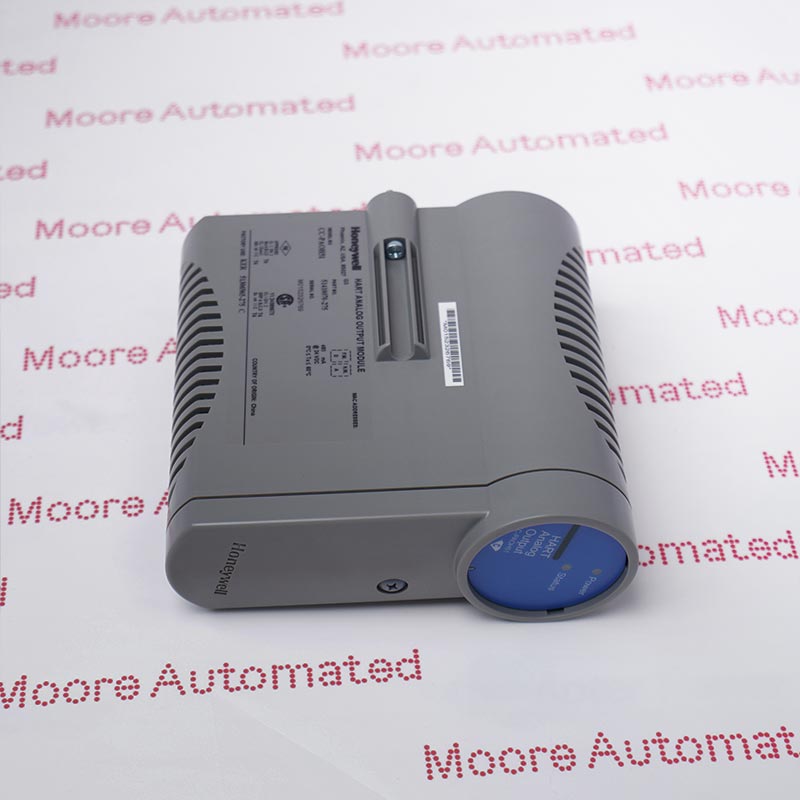


CC-PAOH51 is a Honeywell Series C HART analog output module with 16 current-output channels for actuators, positioners and indicating devices. It provides 4–20 mA control signals, HART device status/configuration and configurable channel failure responses. The module uses a CC-TAOX51 non-redundant or CC-TAOX61 redundant IOTA; the existing product photograph identifies manufacturer part 51410070-275.
The Honeywell CC-PAOH51 converts control commands into sixteen regulated current outputs for process actuators and compatible recording or indicating equipment. Normal control uses the 4–20 mA range, while the documented directly settable values include zero and 2.9–21.1 mA. HART communication supplements the analog command with device status and configuration access. A CC-TAOX51 IOTA provides the non-redundant arrangement; a CC-TAOX61 provides the redundant arrangement. Their nominal six-inch and twelve-inch dimensions describe the termination boards, not the module's shipping package.
Commissioning requires more than confirming the channel count. The loop must remain within the specified resistance and compliance limits, and the controller must use supported hardware, firmware and HART settings. Honeywell's comparison lists sixteen HART communication units for this model and excludes certain one-second and two-second scan choices available on CC-PAOH01. The common AO-HART block therefore does not establish equivalent hardware or permit an arbitrary mixed redundant pair. Each channel's failure setting and actuator response should be tested against the process design, including the separate case of electronics failure driving the output to zero.
The specified maximum resistive load is 800 Ω when the nominal 24 V supply is within 22–28 Vdc. Under the same supply condition, maximum output compliance is 16 V; maximum open-circuit voltage is separately listed as 22 V. Include the actuator, cable and other series elements in the loop assessment. An unloaded voltage reading alone does not demonstrate that the circuit can deliver its full commanded current.
Each output channel can be configured to retain its last value or move to a selected safe value under the applicable FAILOPT condition. This must not be confused with an IOM electronics failure, for which Honeywell specifies zero output current. Verify the actuator's response to both cases during an approved loop test. The module can also report an open field wire as a channel soft failure.
Honeywell lists sixteen HART communication units for CC-PAOH51. The model comparison excludes the 1 Sec Dynamic, 1 Sec Device and 2 Sec Device and Dynamic scan choices supported by CC-PAOH01. It also states that field calibration is not required. Check the actual controller release, device requirements and configured scan selections; matching the AO-HART block name does not remove the hardware and IOTA compatibility requirements.
Evaluate the complete current loop, including the receiving device, wiring and any additional series components. The official 800 Ω load limit and 16 V maximum compliance specification apply with a 22–28 Vdc supply. Verify commanded current under load instead of relying only on an open-circuit voltage measurement. The ±4% full-scale readback figure is a diagnostic measurement specification; it must not replace the tighter calibrated output accuracy when calculating the control-loop error budget.
Select and document each channel's FAILOPT behavior according to the process design, then verify the final actuator response during approved commissioning. A configured hold-last or safe-value action does not override the documented zero-current outcome of IOM electronics failure. Redundant operation additionally permits a zero-current switchover gap of up to 10 ms. Confirm that the receiving device tolerates this interruption and that both modules, firmware and the CC-TAOX61 termination arrangement form a supported combination.

Registered Address: 32D Floor Guomao Building, No.388, Hubin South Road, Siming District, Xiamen,Fujian, China
MooreAutomated.com is the official website and primary online platform operated by Moore Automation Limited. The website provides information about the company’s industrial automation parts sourcing services, product coverage and customer support. Moore Automation Limited operates as an independent supplier and is not an authorized distributor or representative of the manufacturers displayed on this website unless expressly stated.