




Registered Address: 32D Floor Guomao Building, No.388, Hubin South Road, Siming District, Xiamen,Fujian, China
ISO 9001:2015 Certified
Our quality management system covers sourcing,testing and dispatch
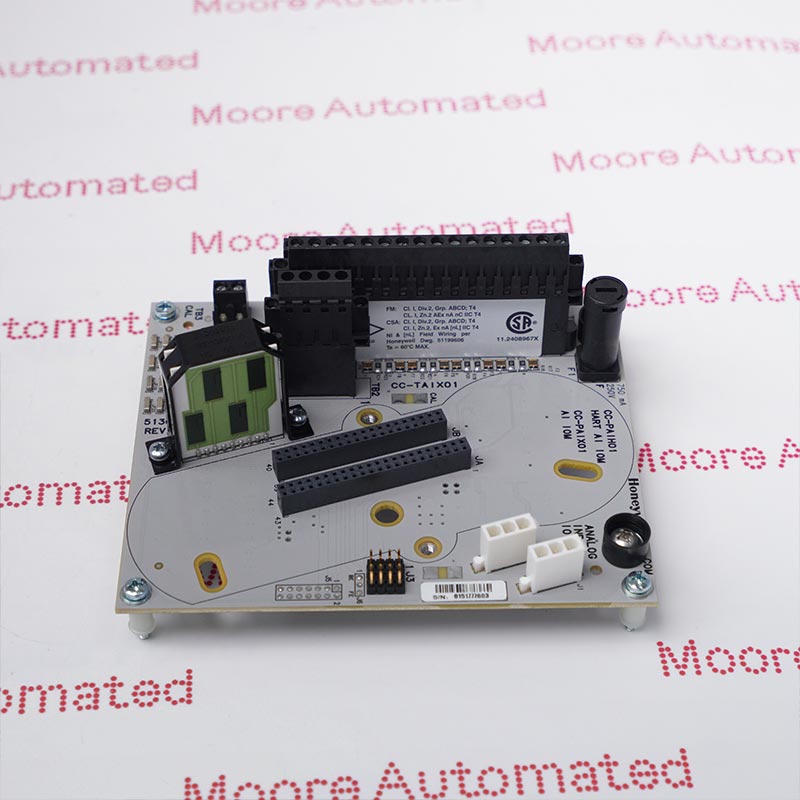


CC-TAIX01 51308363-175 is Honeywell's coated, nonredundant Series C analog input termination assembly. It provides field connections for 16 channels, a 32-position TB1 terminal arrangement and four TB2 connections for the low side of channels 13-16 when configured for differential service. The original spare-parts table confirms the complete part-number pairing. Analog conversion and HART processing belong to the fitted IOM; this IOTA supplies the mounting, termination and protected field-power interface.
Honeywell identifies CC-TAIX01 51308363-175 as a coated, nonredundant analog input termination assembly. Its field interface uses thirty-two TB1 screw positions for sixteen channels, with power on odd-numbered positions and returns on even-numbered positions. Four TB2 positions provide the low-side connections associated with channels 13-16. The board is designed for compatible Series C analog input electronics, including the documented CC-PAIH02 and CC-PAIX02 arrangements. A/D resolution, measurement accuracy and HART processing are attributes of the installed IOM and configuration, not standalone specifications of this termination board.
The original wiring instructions permit standard two-wire transmitters on all sixteen channels without custom wiring or jumper cuts. Voltage inputs and certain externally grounded devices require the specified jumper and channel arrangements; device-grounded voltage inputs are restricted to channels 13-16 in the guide's wiring table. Inspect the existing jumper state before selecting a spare because cut jumpers cannot be restored. The recommended spare-parts list specifies two sixteen-terminal plug assemblies, one four-terminal plug assembly and one 750 mA fast-acting F1 fuse for the nonredundant IOTA. Confirm which of these items are included with the offered board.
The original compatibility matrix lists CC-TAIX01 with CC-PAIH02 HART and CC-PAIX02 non-HART modules. It permits differential arrangements on channels 13-16, unlike CC-TAID01, which supports all-channel differential wiring. Verify the module generation, input mode and receiving system before approval. A similar connector or a redundant board does not establish drop-in compatibility.
TB1 uses positions 1-32 for sixteen input channels: each odd-numbered position is the power screw and the following even-numbered position is the return. TB2 positions 1-4 correspond to the low side of channels 13-16 when the approved differential configuration is used. Field terminations accept up to 14 AWG stranded wire. Preserve the wiring labels and inspect the terminal-plug condition during replacement.
JP1-JP16 are associated with the channel current-sensing paths. Voltage-input arrangements require the specified range-spool jumper to be cut; JP17-JP20 relate to TB2 and differential or device-grounded connections on channels 13-16. These are permanent hardware changes, not software selections. A qualified technician should follow the complete Honeywell wiring diagram and confirm the intended loop before altering a jumper.
Record whether each transmitter is loop-powered, self-powered or grounded at the device before moving field connections. Standard two-wire loops can use all sixteen channels. The guide restricts device-grounded voltage sources to channels 13-16; some system-grounded arrangements on channels 1-12 need additional engineered wiring. Check TB2 use and existing jumper cuts against the full wiring table rather than assuming that every channel has identical connection options.
Inspect the nonredundant board's F1 fuse and both sets of field connectors before installation. Honeywell lists a 750 mA, 5 x 20 mm fast-acting fuse, part 51190582-175. A blown F1 interrupts power to the IOM and its field-power feeds. The documented plug set comprises two 51506273-216 sixteen-terminal assemblies and one 51506269-204 four-terminal assembly. Confirm these accessories and the board's irreversible jumper state in the supplied-item description.

Registered Address: 32D Floor Guomao Building, No.388, Hubin South Road, Siming District, Xiamen,Fujian, China
MooreAutomated.com is the official website and primary online platform operated by Moore Automation Limited. The website provides information about the company’s industrial automation parts sourcing services, product coverage and customer support. Moore Automation Limited operates as an independent supplier and is not an authorized distributor or representative of the manufacturers displayed on this website unless expressly stated.