Overview
Manuals
How It Works
Application Details
Features:
- Remote Expansion Cable
- From Fibre TX/RX unit (T8314) to Expander Processor (T8310)
- Designed specifically for Trusted Triple Modular Redundancy (TMR) safety instrumented systems
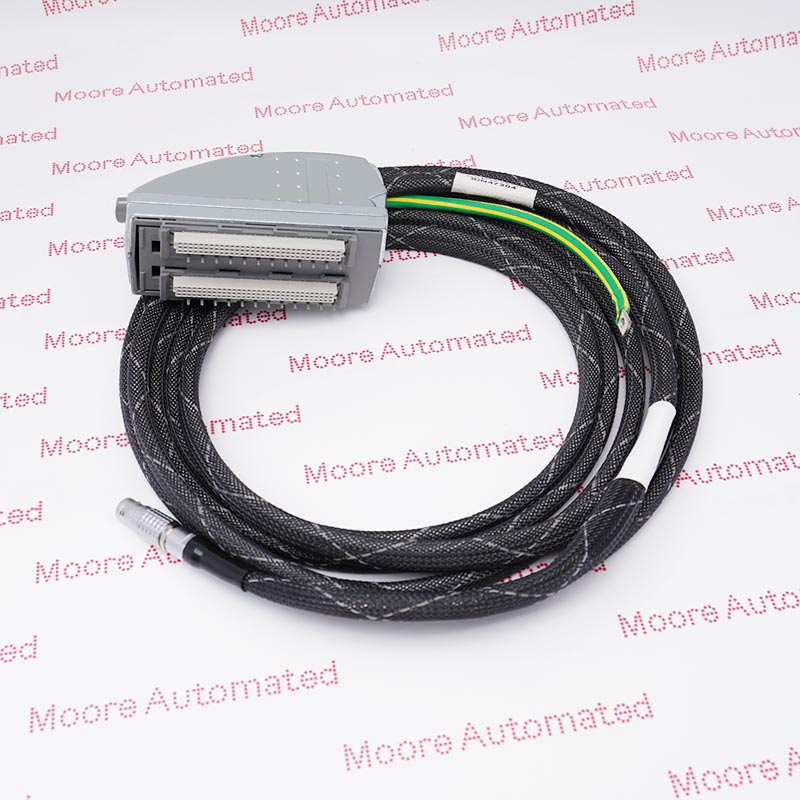
The ICS Triplex TC-303-02-4M0 (one of Rockwell Automation's ICS Triplex Trusted Core Security Series products) is a highly fault-tolerant remote extension communication cable assembly designed for Triple Modular Redundancy (TMR) critical control systems. As a high-physical-specification interconnect component in distributed rack topologies, it is specifically designed to precisely connect Trusted Fiber Transceiver Units (T8314) in control room main racks or communication networks to Trusted Extender Processors (T8310) located in remote Trusted Extender chassis.
In terms of functionality and performance, the TC-303-02-4M0 communication component strictly complies with the highest Industrial Safety Integrity Level (SIL 3) certification standards, possessing extremely high noise immunity and suitable for remote data synchronization relay and all-weather link isolation protection. Its cable features a Cat 5 independent shielding layer and an ultra-low smoke halogen-free (LSZH) advanced safety sheath (compliant with TC-303-02 specifications), specifically designed for harsh industrial electromagnetic and physical noise environments. This not only provides excellent flame retardancy and low waveform distortion but also ensures perfect compatibility with fiber optic transmission systems and effectively resists large-area, strong electromagnetic interference.
The TC-303-02-4M0 ICS Triplex Remote Expander Cable (Expander End), 4.0m may still be available for purchase and support from Moore Automated Company beyond End-Of-Life (EOL) by the manufacturer (OEM).
ICS Triplex TC-303-02-4M0 Remote Expander Cable (Expander End), 4.0m Manuals(Datasheets), Link
Important Notice: Other accessories, manuals, cables, calibration data, software, etc. are not included with this equipment unless listed in the above stock item description. All prices are shown in USD.
The ICS Triplex TC-303-02-4M0 operates based on its specially designed asymmetric interface architecture and TMR three-channel physical isolation and splitting logic. During link operation, the end of the component connected to the remote T8310 extended processor (SKT2) is equipped with a 96-pin C-type industrial connector with high shock resistance (featuring a double-width heavy-duty metal protective shell and a safety grounding braid), while the end connected to the T8314 fiber optic transceiver consists of three independent 4-pin LEMO connectors, corresponding to the three fully isolated core physical channels A, B, and C in the TMR architecture. Remote optical signals from the main rack are converted into photoelectric signals by the T8314.
These three redundant electrical signals are then input through three 4-pin connectors into independently shielded twisted-pair pairs within a 4.0-meter fiber optic cable. Protected by a high-density braided shield (external noise is safely released to system ground in real time through the grounding braid), the signal is transmitted at high speed and without loss to the 96-pin C-type connector. Ultimately, the signals are injected in parallel into the T8310 extended processor with perfectly equal and microsecond-level clock consistency. This perfectly realizes the TMR system's signature fault-tolerant operation without single points of failure, and applies it to the remote physical extension layer.
1. Long-distance Fiber Optic Extension Between Chassis (Ultimate Link): When factory architectures require extending secure I/O modules between remote processing areas, independent control rooms, or offshore platforms, copper cabling attenuation reaches its limits. To compensate for this, engineers deploy reliable fiber optic communication links.
2. High Electromagnetic Interference (EMI) Environments: Copper busbars are highly susceptible to induced noise in environments containing large variable frequency drives (VSDs), large industrial motors, gas turbine igniters, or high-voltage switchgear.
3. Cross-panel cabling in segmented control cabinets: Industrial control cabinets typically isolate field power terminals, fiber optic patch cords, and core logic processing hardware into separate, independent vertical cabinets to prevent accidental contact during live maintenance.