Overview
Manuals
Core Technical Features
Operating Principle
Features:
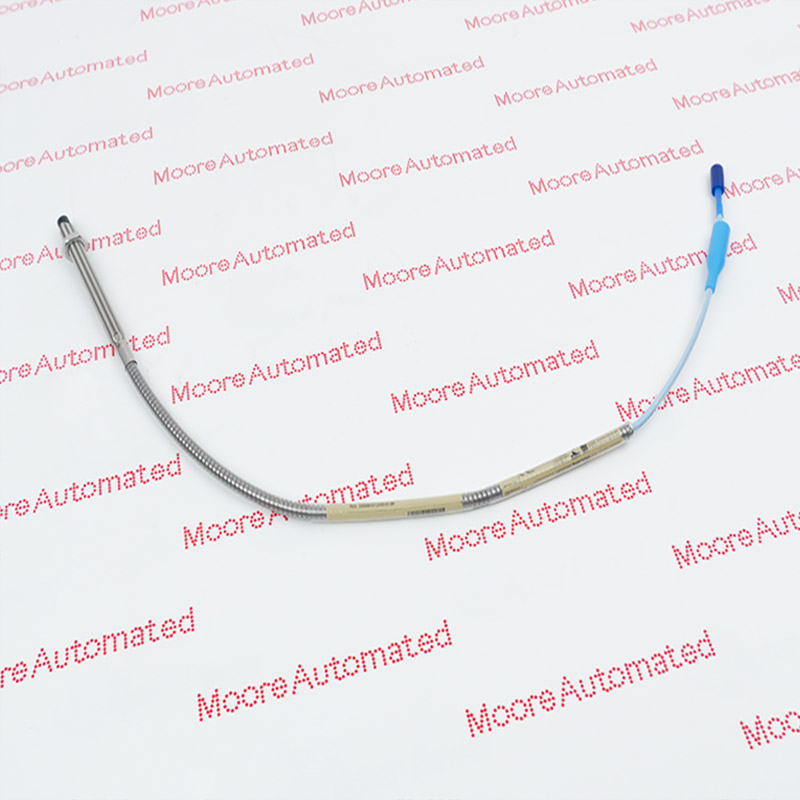
- Total Length 0.5 metres (approximately 20 inches)
- Part of the 0.300” series, its standard linear range is 1.25 mm (50 mils) to 2.03 mm (80 mils)
- Depending on the calibration of the target material
As a front-end sensing element in mechanical protection systems (such as the Bently Nevada 3500 system), it is designed to acquire precise data on physical changes in high-load, high-vibration industrial environments. Its core function is to monitor bearing dynamics, rotor displacement, and minute anomalies in the mechanical housing in real time, thereby preventing catastrophic downtime caused by wear or imbalance.
When the detected amplitude, axial displacement, or temperature parameters exceed a preset safety threshold, the sensor, in conjunction with the monitoring module, can immediately trigger an alarm or directly activate the automatic shutdown interlock mechanism. This precise function makes it widely used in core industrial sectors with extremely high requirements for production continuity and safety, such as the oil and gas, heavy power, and chemical industries.
The 83607-00-75-05-02 Bently Nevada SENSOR UNIT may still be available for purchase and support from Moore Automated Company beyond End-Of-Life (EOL) by the manufacturer (OEM).
Bently Nevada 83607-00-75-05-02 SENSOR UNIT INFO(Datasheets), Link
Important Notice: Other accessories, manuals, cables, calibration data, software, etc. are not included with this equipment unless listed in the above stock item description. All prices are shown in USD.
Radiation Hardening: Utilizes specially designed ceramic-metal seals and advanced insulation materials to withstand cumulative gamma radiation, while standard epoxy probes age rapidly.
Baker Hughes DAM Matching System Specifications: Belongs to the 0.300-inch series, with a standard linear range of 1.25 mm (50 mils) to 2.03 mm (80 mils), depending on the calibration of the target material.
Baker Hughes DAM Remote Control Function: Can be used with radiation-hardened extension cables to move radiation-sensitive Proximitor electronics from confined areas with the highest radiation exposure to locations up to 110 feet (33.5 meters).
The 83607-00-75-05-02 Sensor is primarily based on the principle of eddy current induction, measuring the relative positional change between the sensor end face and the measured metal conductor (e.g., a rotating shaft).
During operation, the accompanying preamplifier emits a high-frequency AC signal to the probe head, causing the internal coil of the probe to generate a high-frequency alternating electromagnetic field. When the surface of the measured metal shaft approaches this magnetic field, due to electromagnetic induction, reverse eddy currents are generated on the metal surface, absorbing the energy of the electromagnetic field. This causes a change in the impedance and high-frequency oscillation amplitude of the probe's internal coil.
The precision circuitry inside the preamplifier captures and modulates this amplitude change, converting it into a linear voltage signal proportional to the distance between the probe and the shaft surface. The system can then accurately calculate the vibration frequency, amplitude, and minute displacement of the rotating shaft during operation.