










Get Repair Quote
Name
Company *
Phone *
Email *
Address
City
State / Province / Region
Zipcode
Country
Quantity *
Part Number *
Manufacturer
Preferred Condition
Additional Information
Cancel
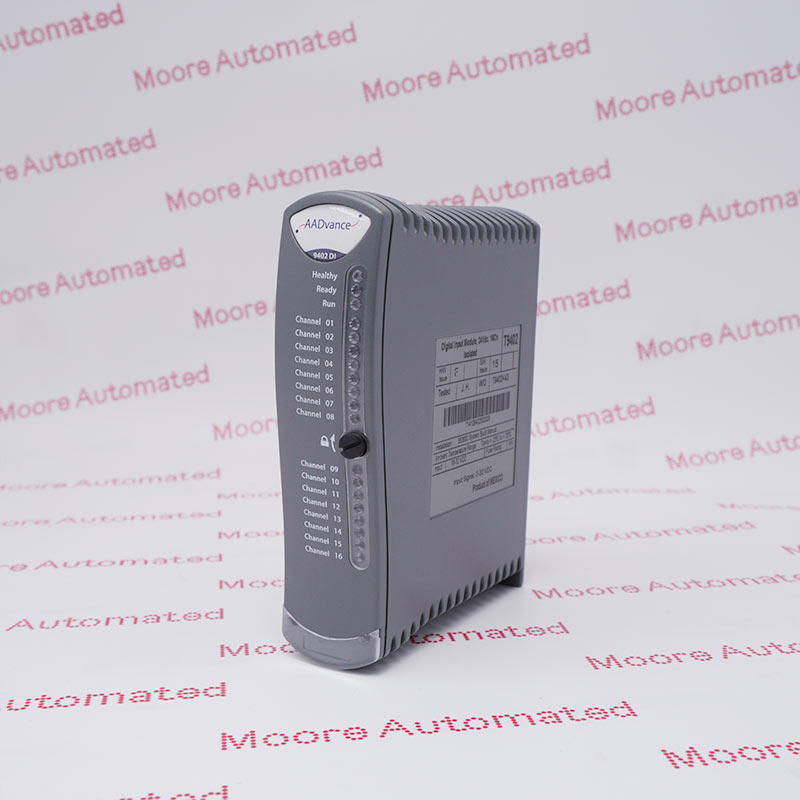
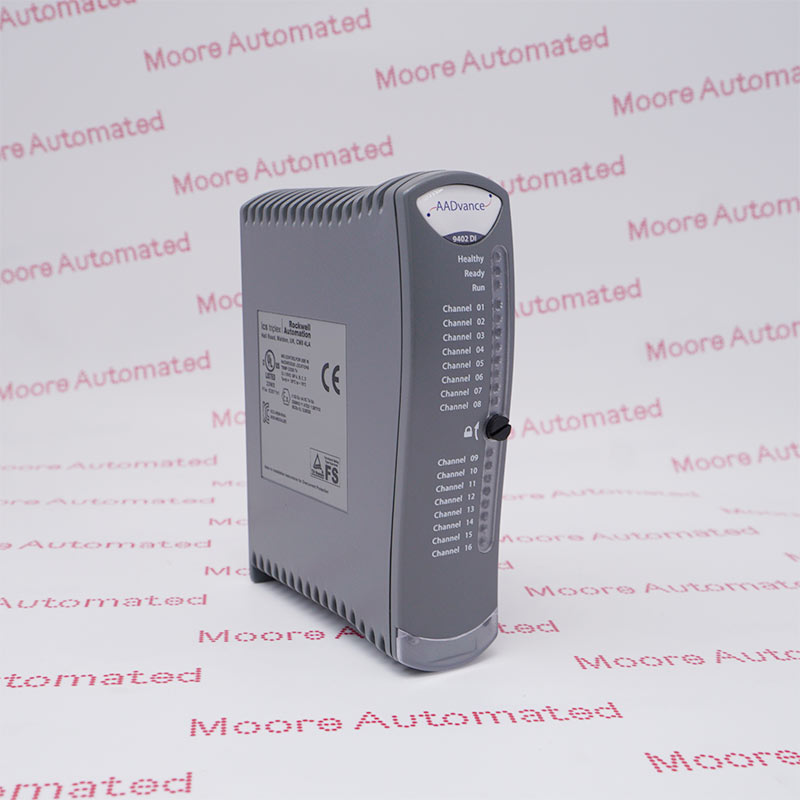
ICS Triplex T9402
ICS Triplex T9402
ICS Triplex T9402
ICS Triplex T9402
ICS Triplex T9402
ICS Triplex T9402
· Product image is representative; revision or series may vary. Contact us to request a specific version.

T9402

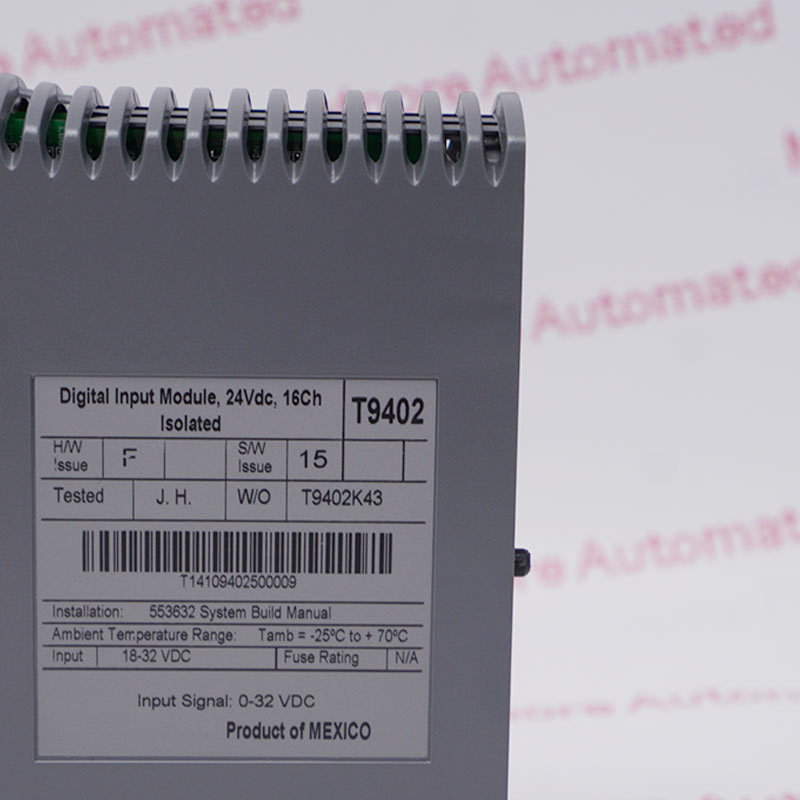
16-channel digital input module
In Stock

Product Information:

16-channel digital input module

in the AADvance series,  It is a core

component of the AADvance control

system

Expand All
Collapse all

Technical specifications for T9402

  • Manufacturer:
    ICS Triplex
  • Product Category:
    PLC System
  • Estimated shipping dimensions:
    4x12.3x16.5cm
  • Weight:
    0.36 kg
  • Tariff Code:
    8537101190
  • Country of origin:
    USA
  • Place of shipment:
    Xiamen, Fujian, China
  • Operating Voltage:
    24 V DC
  • Frequency Range:
    50Hz
  • Number of channels:
    16 channel, isolated
  • scan:
    0.924 ms
  • Voltage Range (Vdc):
    18-32 VDC
  • Maximum Current (mA):
    260mA
  • Input/Output Electrical Ratings:
    Input: 0-32 Vdc @ 6.5 mA
  • Stock:
    50

Information

Overview Manuals Principle Primary Applications

Features:

  • 16-channel digital input module
  • Triple Modular Redundant (TMR), fault tolerant (3-2-0) operation
  • Hardware Implemented Fault Tolerant (HIFT) architecture
The Trusted TMR processor is a fault-tolerant design based on a Triple Module Redundancy (TMR) architecture, operating in a synchronous configuration. Figure 1 illustrates the basic structure of the Trusted TMR processor module in a simplified manner.

The module comprises three Processor Fault Isolation Regions (FCRs). Each FCR contains an NXP PowerQUICC® II™ series processor and its associated memory (EPROM, DRAM, Flash ROM, and Flash RAM), memory-mapped I/O, a voter, and glue logic. Each processor FCR employs a 2/3 (2oo3) read permission voting mechanism to vote on the memory systems of the other two processor FCRs to eliminate operational discrepancies.

The T9402 ICS triplex 16-channel digital input module may still be available for purchase and support from Moore Automated Company beyond End-Of-Life (EOL) by the manufacturer (OEM).
ICS Triplex T9402 16-channel digital input module maunal(Datasheets), Link Important Notice: Other accessories, manuals, cables, calibration data, software, etc. are not included with this equipment unless listed in the above stock item description. All prices are shown in USD.
The three processors in this module are responsible for storing and executing applications, scanning and updating I/O modules, and detecting system faults. Each processor executes applications independently but operates synchronously with the other two processors. Each processor has an interface that includes an input voter, discrepancy detection logic.
The T9402 is a core component of systems designed to protect industrial processes and personnel. Its most common applications include:
Emergency Shutdown Systems (ESD): Used to monitor critical field sensors (e.g., emergency stop buttons, limit switches) to trigger immediate safety shutdowns of machines or processes.
Fire and Gas Detection (F&G): Serves as an input interface to smoke, heat, and gas detectors, providing reliable data needed to activate fire suppression or alarm systems.
Burner Management System (BMS): Monitors flame scanners and fuel valve positions to ensure the safe startup and operation of industrial boilers and furnaces.
Critical Process Control: Applied to scenarios where signal failures could lead to significant business losses or environmental damage, such as high-pressure vessel monitoring.

Ask our team:

  • What is the principal functional designation of the T9402 within a high-integrity control or safety system topology? The T9402 is typically classified as a power supply or system support module within a safety-critical control architecture. Its primary role is to deliver regulated and reliable power to associated modules, ensuring uninterrupted operation of the control system under demanding industrial conditions. Q2: How does the T9402 maintain voltage stability and mitigate disturbances in electrically noisy industrial environments? The T9402 integrates advanced power regulation circuitry, including filtering, surge suppression, and transient protection mechanisms. These features ensure stable output voltage while minimizing the impact of electromagnetic interference (EMI), voltage fluctuations, and transient spikes commonly encountered in industrial installations. Q3: In what types of mission-critical applications is the T9402 most appropriately implemented, and what advantages does it confer? The T9402 is widely deployed in sectors such as oil & gas, power generation, and process automation, where system uptime and reliability are paramount. Its high availability design and robust electrical performance make it particularly suitable for safety instrumented systems (SIS) and distributed control systems (DCS). Q4: What redundancy and fail-safe characteristics are associated with the T9402 in fault-tolerant system configurations? The T9402 is often utilized within redundant power architectures, supporting parallel operation or hot-swappable configurations. It includes built-in diagnostic and protection features such as overvoltage, overcurrent, and thermal shutdown, thereby enhancing system resilience and ensuring continuous operation in the event of component-level faults. Q5: How does the T9402 facilitate seamless integration with other modules in a modular control system framework? The T9402 interfaces with system backplanes or power distribution buses, supplying conditioned power to interconnected modules. Its standardized electrical and mechanical design ensures compatibility with modular system architectures, enabling efficient installation, maintenance, and scalability. Q6: What diagnostic and monitoring capabilities are embedded within the T9402 to support operational transparency? The T9402 incorporates status indication and diagnostic feedback mechanisms that provide real-time information on power health, load conditions, and fault states. These features enable operators to perform proactive maintenance and quickly identify abnormal operating conditions. Q7: How does the T9402 contribute to overall system reliability and lifecycle performance? The T9402 enhances system reliability by delivering consistent power with minimal ripple and high efficiency. Its ruggedized design and protective features reduce the risk of failure, thereby extending the operational lifespan of both the module itself and the connected system components. Q8: What is the underlying operational principle governing the T9402’s power conversion and delivery process? The T9402 operates based on switch-mode power supply (SMPS) technology. Incoming electrical power is first rectified and then converted into a high-frequency signal through switching devices. This signal is processed via transformers and filtering circuits to produce a stable, regulated DC output. A closed-loop feedback control system continuously monitors the output and adjusts switching behavior to maintain precise voltage regulation, ensuring efficient and reliable power delivery to the control system.
    The T9402 is typically classified as a power supply or system support module within a safety-critical control architecture. Its primary role is to deliver regulated and reliable power to associated modules, ensuring uninterrupted operation of the control system under demanding industrial conditions.
  • How does the T9402 maintain voltage stability and mitigate disturbances in electrically noisy industrial environments?
    The T9402 integrates advanced power regulation circuitry, including filtering, surge suppression, and transient protection mechanisms. These features ensure stable output voltage while minimizing the impact of electromagnetic interference (EMI), voltage fluctuations, and transient spikes commonly encountered in industrial installations.
  • In what types of mission-critical applications is the T9402 most appropriately implemented, and what advantages does it confer?
    The T9402 is widely deployed in sectors such as oil & gas, power generation, and process automation, where system uptime and reliability are paramount. Its high availability design and robust electrical performance make it particularly suitable for safety instrumented systems (SIS) and distributed control systems (DCS).
  • What redundancy and fail-safe characteristics are associated with the T9402 in fault-tolerant system configurations?
    The T9402 is often utilized within redundant power architectures, supporting parallel operation or hot-swappable configurations. It includes built-in diagnostic and protection features such as overvoltage, overcurrent, and thermal shutdown, thereby enhancing system resilience and ensuring continuous operation in the event of component-level faults.
  • How does the T9402 facilitate seamless integration with other modules in a modular control system framework?
    The T9402 interfaces with system backplanes or power distribution buses, supplying conditioned power to interconnected modules. Its standardized electrical and mechanical design ensures compatibility with modular system architectures, enabling efficient installation, maintenance, and scalability.
Quantity
Upload
(gif, jpg, jpeg, png, bmp, doc, docx, xls, xlsx, ppt, pdf, csv)
For more information on how your data is processed and stored by Moore automated please read our privacy policy.
Trusted by 5,000+ plants worldwide | Backed by our vast inventory of top-tier control parts, drives and servo motors, fast shipments are dispatched to cover your urgent needs. ABOUT US >>
Moore Disclaimer: Moore Automated's sales automation equipment and related solutions are intended for industrial automation and business operational efficiency improvement purposes only. Product information, technical parameters, and application cases are for reference only and do not constitute an absolute guarantee of performance for any specific industry, scenario, or final application. Actual equipment performance may vary depending on factors such as the usage environment, system integration method, and maintenance conditions. Users should confirm compatibility and safety based on professional technical assessments. Moore Automated assumes no liability for any direct or indirect losses caused by improper use, modification, or failure to operate according to specifications, to the extent permitted by law.